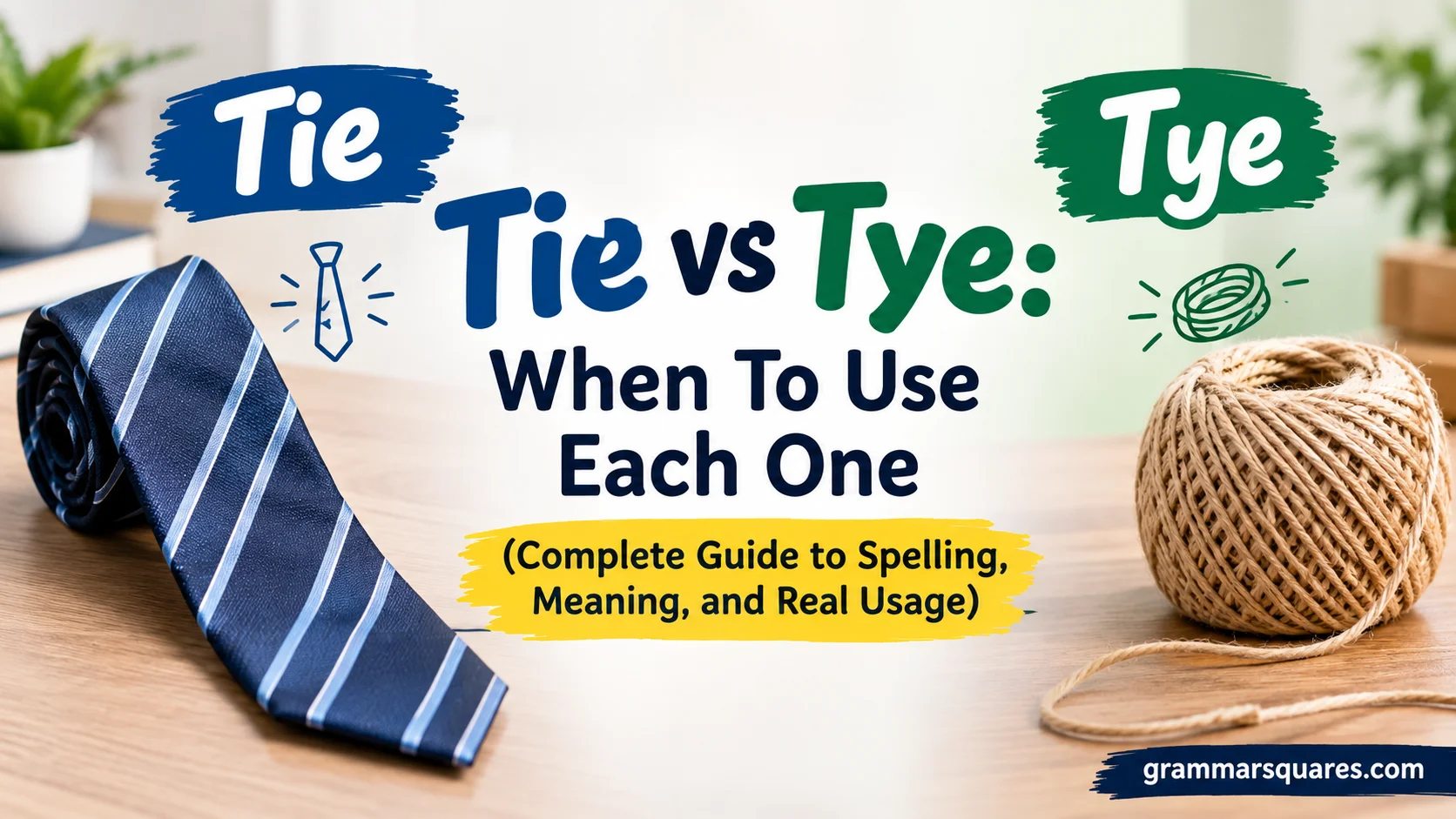

Tie vs Tye can sound exactly the same when spoken, but their spelling, meaning, and use differ in modern English and everyday writing contexts. This pair of English words can seem interchangeable because tie and tye look the same and sound identical. However, in standard modern English, tie has the correct spelling for everyday writing. It can mean to fasten, bind, or describe fastening and binding. It can also mean a piece of clothing worn around the neck, or neckwear. In a competition, a tie can mean an equal result, while it can also describe a connection between people or organizations. From my experience explaining English spelling, this simple rule prevents much confusion: use tie in normal language, whether you write in British English or American English. The spelling often causes trouble in writing, exams, and online searches, but the basic distinction is easier than it first appears.
Tye is less common and has different definitions, uses, and contexts. As an English word, it can refer to a chain on a ship, while it may also appear in special situations as a surname, surnames, place names, an established name, or an established place. It can also occur in historical English as an old form or historical term, so calling every use a spelling mistake or outdated form can be misleading without checking the context. This distinction matters in schools, offices, sports broadcasts, newspapers, books, everyday conversations, emails, essays, captions, and professional writing.
In this article and guide, the examples, origins, grammar rules, common errors, and practical usage clarify the meaning, meanings, usage, frequency, and correct usage of tie vs tye. For writers, students, and native English speakers, understanding why these words are identical in sound but different in English spelling can build confidence, prevent spelling mistakes, and make it easier to fix the mistake instead of memorizing a confusing rule. The main challenge is knowing when tye works as a proper noun or historical form and when tie is the ordinary word. That distinction keeps each sentence clear and helps you choose the right word with confidence.
Tie vs Tye: The Short Answer You Can Trust
Let’s clear the fog quickly.
- Tie → the correct standard English word
- Tye → a rare proper noun (names, places, or surnames)
If you’re writing about actions, objects, or ideas, you want tie every single time.
Example:
- ✔ I need to tie my shoes before leaving.
- ✘ I need to tye my shoes before leaving.
That’s the foundation. Now let’s go deeper so you never second-guess yourself again.
Why “Tie vs Tye” Confuses So Many People
English spelling doesn’t always match sound. That’s the core problem here.
When you say the word tie, it sounds like it could be spelled in multiple ways:
- tie
- tye
- tai
- ti
Your brain naturally guesses based on patterns it has seen elsewhere. And that’s where things go wrong.
Three main reasons people write “tye”
- Phonetic guessing You write what you hear, not what standard spelling requires.
- Fast typing habits On mobile keyboards, your fingers move faster than your attention.
- Name exposure bias You may have seen “Tye” as a name and subconsciously copied the structure.
Here’s the interesting part: your brain isn’t careless. It’s pattern-matching. It just learned the wrong pattern.
What “Tie” Actually Means in Real English
The word “tie” is flexible. It works in several everyday contexts, which makes it powerful—and also more confusing.
Let’s break it down clearly.
Tie as a physical action (fastening or securing)
This is the most common meaning.
You use it when something gets bound, knotted, or secured.
Examples:
- I tie my shoelaces every morning.
- She tied the rope tightly around the pole.
- He ties a scarf before going outside.
Think of “tie” as anything that creates a connection using force or wrapping.
👉 Simple mental image: Two ends meeting and locking together.
Tie as a connection or relationship
Here, “tie” becomes more abstract. It refers to bonds between things or people.
Examples:
- Family ties remain strong despite distance.
- Cultural ties connect communities across borders.
- Business ties grew between the two companies.
This meaning shows up often in writing and journalism.
👉 Analogy: Think of invisible strings linking people together.
Tie in sports and competition
In sports, a tie means equal score.
Examples:
- The match ended in a tie.
- Both teams played to a tie after overtime.
In American English, “tie” is common. In British English, people may also say “draw,” but “tie” still appears in certain contexts.
👉 Quick rule:
- Tie = equal result
- Draw = same idea (more British usage)
Tie as clothing (necktie)
This one is easy to spot.
A tie is the long piece of fabric worn around the neck.
Examples:
- He wore a black tie to the wedding.
- The dress code requires a tie and suit.
Fashion writing relies heavily on this meaning.
Where “Tye” Actually Appears (Rare but Real)
Now let’s talk about the only time “tye” is correct.
You almost never use it as a regular English word. Instead, it shows up in proper nouns.
Common situations where “Tye” is valid
- Surnames (family names)
- Geographic names
- Specific brands or historical references
Examples of real usage
- Tye Sheridan (actor name)
- Tye River (geographic location in the United States)
In these cases, the spelling is fixed. You don’t change it.
👉 Rule of thumb: If it looks like a name, keep “Tye.” If it describes an action or object, use “tie.”
Quick Comparison Table: Tie vs Tye
CategoryTieTyeStandard English word✔ Yes✘ NoAction (knot, fastening)✔ Yes✘ NoSports result✔ Yes✘ NoClothing✔ Yes✘ NoProper noun (names)✔ Yes✔ YesEveryday writing✔ Always✘ Rare
This table makes one thing obvious: “tie” dominates real usage.
Why English Uses “Tie” Instead of “Tye”
Let’s zoom out for a second and look at language evolution.
The word “tie” comes from Old English roots related to binding or fastening. Over time, English simplified spelling patterns for common words.
“Tye” never became part of standard spelling because:
- It didn’t appear consistently in written English
- It stayed limited to names and regional usage
- Standard dictionaries settled on “tie”
Language tends to favor efficiency. If one spelling dominates usage, it wins.
👉 Simple takeaway: English standardized “tie” and left “tye” behind.
Why Your Brain Wants to Write “Tye” Anyway
This is where things get interesting.
Your brain prefers consistency. It looks for patterns like:
- “bye”
- “eye”
- “die”
So it assumes:
“If similar words end in -ye, then tie should follow too.”
But English doesn’t always cooperate with logic. It mixes history, borrowing, and evolution.
👉 Think of English as a patchwork quilt, not a clean system.
Memory Tricks to Never Confuse Tie vs Tye Again
Let’s make this practical. You don’t need grammar theory. You need shortcuts.
Trick 1: The “word test” method
Ask yourself:
- Can I replace it with “knot” or “bind”?
If yes → use tie
Example:
- tie your shoes → knot your shoes ✔
Trick 2: The “name rule”
If it looks like a person or place → it might be “Tye.”
Otherwise → stick with “tie.”
Trick 3: The “E comes first” rule
Think:
“Tie has the real English word first (E in spelling order).”
It’s silly, but it sticks.
Common Mistakes People Make (and How to Fix Them)
Let’s look at real-world errors.
Mistake 1: Shoes
- ❌ I need to tye my shoes
- ✔ I need to tie my shoes
Fix: Think “knot your shoes.”
Mistake 2: Sports result
- ❌ The game ended in a tye
- ✔ The game ended in a tie
Fix: Sports always use “tie.”
Mistake 3: Fashion
- ❌ He wore a tye with his suit
- ✔ He wore a tie with his suit
Fix: Clothing uses “tie” only.
Mini Practice Section (Test Yourself)
Try filling in the blanks:
- She wore a black ___ to the ceremony.
- The match ended in a ___ after overtime.
- I forgot to ___ my shoelaces.
- Tye Sheridan is an actor, but we still ___ our shoes.
- Family ___ keep people connected.
Answers
- tie
- tie
- tie
- tie
- ties
If you got all of them right, you’ve mastered the rule.
Read More: Space-Related Words Starting With I: A Complete Astronomy and Space Science Glossary
Real-World Usage Examples (Context Matters)
Let’s see how professionals use “tie” in different writing styles.
News Writing
- “The election resulted in a tie, prompting a recount.”
Sports Commentary
- “Both teams fought hard, but the match ended in a tie.”
Business Writing
- “Strong trade ties between the countries boosted exports.”
Everyday Conversation
- “Can you help me tie this knot?”
Notice how flexible the word becomes depending on context.
The Hidden Grammar Insight Most People Miss
Here’s something interesting.
English often uses one word for multiple meanings. “Tie” is a perfect example:
- Action (tie shoes)
- Object (necktie)
- Result (tie game)
- Relationship (family ties)
That’s why confusion happens. One spelling carries multiple ideas.
👉 Think of “tie” as a multitool in language. It handles many jobs, but it never changes spelling.
Quick Reference Rules You Can Rely On
Keep this simple checklist in mind:
- Use tie for:
- Actions (fasten, knot)
- Objects (necktie)
- Results (sports)
- Relationships (connections)
- Use Tye only for:
- Names
- Places
- Specific proper nouns
If you follow this, you’ll never guess wrong again.
Final Takeaway: Stop Overthinking It
Here’s the simplest truth:
You almost never need “tye.”
If you’re writing normally, tie is your default choice every time.
And once you train your brain to see it that way, the confusion disappears. You’ll type it correctly without even thinking about it—like muscle memory.
Language gets easier when you stop fighting it and start recognizing patterns. This is one of those patterns.
So next time your fingers hesitate between tie and tye, you already know the answer.
Tie wins. Every time.
FAQs
Is “tye” ever correct in English writing?
Yes, but only in rare cases. You’ll see “Tye” used in proper nouns like surnames or place names. For example, Tye Sheridan is a known actor. Outside of names, standard English does not use “tye” as a word.
Why do people accidentally write “tye” instead of “tie”?
Most people rely on sound rather than spelling rules. Since “tie” and “tye” sound identical, the brain often guesses incorrectly. Fast typing and exposure to names like “Tye” also increase the mistake.
How can I remember the correct spelling easily?
Use a simple rule: If it’s not a name, always use “tie.” You can also think of tying a knot—both “tie” and “knot” are actions, and only “tie” fits that idea.
Does autocorrect always fix “tye” to “tie”?
Not always. Some keyboards may accept “tye” if it’s recognized as a proper noun. That’s why it’s still important to know the rule yourself instead of relying fully on autocorrect.
Conclusion:
At the end of the day, the difference between tie and tye is actually very small, but the impact of using them incorrectly can make your writing look careless. Here’s the bottom line. Tie is the correct and standard spelling in almost all situations. It covers actions, clothing, sports results, and relationships. Tye only appears in rare proper names and should not be used in general writing. If you remember one thing, make it this: If you’re describing anything you do, see, or experience in everyday English, “tie” is always the right choice. Once you lock that in, you won’t second-guess it again.




1 thought on “Tie vs Tye: When To Use Each One Complete Guide?”