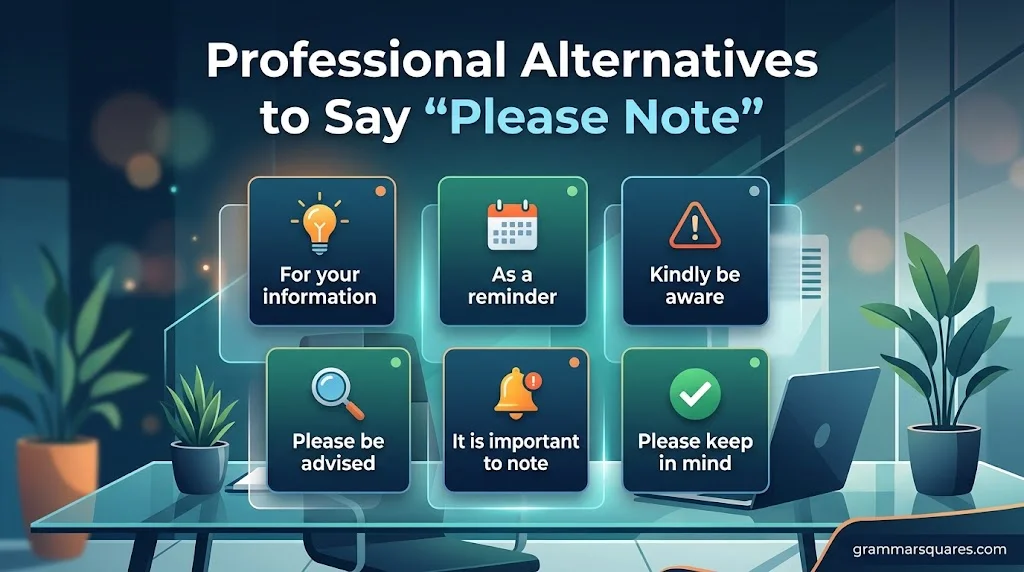

In professional communication, the phrase “Please Note” is often used to highlight important information, share key updates, or draw attention to something that requires careful consideration. Whether you are writing a formal email, preparing a business report, or sending a workplace message, choosing the right words can make your communication more clear and effective. Although this phrase is polite and widely accepted, using it repeatedly can make your writing sound less engaging or somewhat repetitive. Learning different alternatives can help you express your message in a more natural, professional, and confident way.
There are many situations where choosing a suitable alternative to “Please Note” can improve your professional tone and make your message easier to understand. For example, phrases like “Kindly Be Aware,” “Please Keep in Mind,” and “For Your Information” can help you communicate important details without sounding too direct. Each expression has a slightly different meaning and level of formality, so it is helpful to choose your words carefully based on your audience and purpose. In a business email, a polite expression may be appropriate, while a formal announcement may require stronger wording to emphasize an important point.
Understanding how to use professional alternatives to “Please Note” can also help you build better communication skills and create a positive impression in the workplace. The right phrase can make your message sound respectful, thoughtful, and clear, especially when sharing instructions, deadlines, reminders, or essential updates. Instead of relying on the same expression in every situation, you can use varied language to keep your writing interesting and easy to follow. In this guide, you will discover professional alternatives, their meanings, practical examples, and the best situations to use them. These expressions will help you write confidently, avoid repetition, and communicate more effectively in professional settings.
Professional Alternatives to Say “Please Note” in Modern Business Writing
At its core, “please note” means one thing:
“Pay attention to this information because it matters.”
Simple idea. But the phrase itself often feels stiff or overused.
Let’s fix that.
Before we jump into alternatives, you need to understand why this phrase shows up so often in the first place.
What “Please Note” Actually Means in Professional Communication
“Please note” acts as a signal phrase. It tells the reader:
- Something important follows
- You should not skim past it
- The information might affect action, timing, or decisions
You’ll see it in:
- Business emails
- Policy updates
- Internal announcements
- Client instructions
- Reports and proposals
Example of typical usage
Please note that the office will remain closed on Friday.
This works, but it feels a bit formal and repetitive in modern communication.
Now compare it to a more natural version:
The office will remain closed on Friday.
Or even clearer:
The office stays closed on Friday.
Same meaning. Less friction.
That’s the shift happening in workplace writing today.
When You Should Avoid Using “Please Note”
You don’t need to ban the phrase completely, but you should use it carefully.
It weakens impact when overused
If every email starts with “please note,” nothing stands out anymore. The phrase loses its signal power.
It can sound overly formal
Many modern teams prefer direct, human language. Especially in tech, marketing, and customer support.
It adds unnecessary filler
Readers want clarity, not padding. Extra words slow comprehension.
A simple comparison
| Original | Improved |
| Please note that the meeting starts at 3 PM. | The meeting starts at 3 PM. |
| Please note your submission deadline is Friday. | Your submission deadline is Friday. |
Less wording. Same meaning. Faster understanding.
How to Choose the Right Alternative to “Please Note”
You don’t pick replacements randomly. You match them to context.
Think about your audience
Different readers expect different tones:
- Executives prefer concise updates
- Clients expect polite clarity
- Internal teams want quick, direct messaging
- Customers need friendly guidance
Match urgency and intent
Here’s a simple framework:
| Situation | Best Tone |
| General info | Neutral |
| Deadline | Direct |
| Warning or risk | Cautious |
| Reminder | Friendly |
| Instruction | Action-focused |
Ask one key question
“What do I want the reader to do after reading this?”
That answer guides your wording.
Professional Alternatives to Say “Please Note” (With Real Use Cases)
Now let’s break down practical replacements. Each one includes tone, use case, and real examples you can reuse.
Please Be Aware
This phrase works well when you want to signal important information without sounding harsh.
Best use cases
- Policy updates
- Risk notifications
- Compliance information
Tone
Professional, slightly formal, still clear
Example
Please be aware that system maintenance will begin at 10 PM tonight.
This version feels more modern than “please note,” while still maintaining authority.
Keep in Mind
This one feels conversational and natural.
Best use cases
- Instructions
- Planning discussions
- Informal professional emails
Example
Keep in mind that delivery times may vary during holidays.
It sounds like a colleague talking, not a policy document.
Bear in Mind
This version leans slightly more formal than “keep in mind.”
Example
Bear in mind that budget approvals may take up to five business days.
It fits well in corporate reports or managerial communication.
Be Advised
This phrase belongs in more formal or legal environments.
Best use cases
- Legal notices
- Safety warnings
- Compliance updates
Example
Be advised that access to the system will be restricted after 6 PM.
⚠️ Use it carefully. It can feel heavy in casual communication.
We’d Like to Inform You
This works well for structured announcements.
Best use cases
- Customer communication
- Service updates
- Official notices
Example
We’d like to inform you that your account has been successfully updated.
It feels polite without sounding outdated.
For Your Information (FYI)
One of the most commonly used modern replacements.
Best use cases
- Internal communication
- Non-urgent updates
Example
FYI, the client already approved the revised timeline.
Keep it out of formal customer-facing communication.
As a Reminder
Perfect for nudging action without pressure.
Example
As a reminder, invoices are due by the 5th of each month.
It gently pushes the reader toward action.
This Is to Inform You
This version feels structured and formal.
Example
This is to inform you that your request has been processed.
It works well in administrative communication.
Please Remember
Simple, direct, and effective.
Example
Please remember to submit your timesheet by Friday.
It adds polite urgency without sounding strict.
It Is Important to Remember
This version adds emphasis.
Example
It is important to remember that late submissions may affect approval timelines.
Use it when consequences matter.
We Recommend
This shifts tone from instruction to guidance.
Read More: Better Ways to Say “Good Luck in Future Endeavors”
Example
We recommend updating your browser for better performance.
It works well in advisory contexts.
We’d Like to Highlight
Great for drawing attention in reports or summaries.
Example
We’d like to highlight the improvement in customer response times this quarter.
It helps spotlight key points without sounding repetitive.
Attention
This one delivers strong emphasis.
Best use cases
- Bulletins
- Notices
- Alerts
Example
Attention: The office will close early today.
Use sparingly. It can feel abrupt.
Important
Sometimes simplicity wins.
Example
Important: Please reset your password immediately.
It works best in urgent communication.
One Important Detail
This feels conversational and human.
Example
One important detail to keep in mind is the updated refund policy.
It softens the tone while keeping focus.
Here’s an Important Update
Perfect for project communication.
Example
Here’s an important update on the product rollout timeline.
It sets expectations quickly.
It’s Worth Mentioning
This adds a natural conversational tone.
Example
It’s worth mentioning that customer satisfaction increased after the update.
It fits well in reports or blog-style communication.
Keep This in Mind
A slightly more directive variation.
Example
Keep this in mind when planning your next campaign.
Be Sure To
This pushes toward action clearly.
Example
Be sure to attach all required documents before submission.
It works best for instructions.
Don’t Forget
Friendly and informal.
Example
Don’t forget to confirm your attendance.
Avoid it in strict corporate documentation.
You Should Know
Use carefully because it can sound direct.
Example
You should know that this change affects all departments.
It works better in internal communication than external messaging.
Alternatives by Situation (Real-World Mapping)
Let’s simplify decision-making.
Professional Emails
- We’d like to inform you
- As a reminder
- Please be aware
- We’d like to highlight
Customer Service
- We’d like to let you know
- Please remember
- We recommend
- Important
Internal Team Communication
- FYI
- Keep in mind
- One important detail
- Here’s an important update
Legal or Compliance Writing
- Be advised
- This is to inform you
- Please be aware
Friendly Workplace Messages
- Don’t forget
- Keep this in mind
- It’s worth mentioning
Ranked Table of Alternatives (Tone + Strength)
| Phrase | Formality | Tone Strength | Best Use |
| Be advised | Very high | Strong | Legal notices |
| This is to inform you | High | Neutral | Official updates |
| Please be aware | High | Moderate | Policy changes |
| We’d like to inform you | Medium | Neutral | Customer emails |
| Bear in mind | Medium | Moderate | Reports |
| Keep in mind | Low-medium | Friendly | Team communication |
| As a reminder | Low | Gentle | Deadlines |
| Don’t forget | Low | Friendly | Casual reminders |
| FYI | Very low | Neutral | Internal notes |
Common Mistakes When Replacing “Please Note”
Even strong writers slip here.
Overusing formal replacements
If you say “be advised” in every email, it starts sounding robotic.
Picking the wrong tone
A phrase like “attention” can feel too sharp in customer emails.
Ignoring context
A reminder email and a legal notice need different language.
Repeating the same alternative
Variety keeps communication fresh and readable.
Real-World Case Studies
Case Study: Corporate Email Update
Before:
Please note that the deadline has changed to Friday.
After:
The deadline has changed to Friday.
Result: Cleaner, faster reading, fewer filler words.
Case Study: Customer Notification
Before:
Please note your subscription will renew automatically.
After:
We’d like to inform you that your subscription will renew automatically.
Result: More polite and brand-friendly tone.
Case Study: Internal Reminder
Before:
Please note the report is due tomorrow.
After:
As a reminder, the report is due tomorrow.
Result: Softer, less formal, easier to digest.
Quick Reference Guide
| Goal | Best Replacement |
| Inform | We’d like to inform you |
| Remind | As a reminder |
| Highlight | We’d like to highlight |
| Warn | Please be aware |
| Advise | We recommend |
| Update | Here’s an important update |
| Casual note | FYI |
| Action needed | Be sure to |
| Attention | Important |
Conclusion
Using professional alternatives to “Please Note” can make your communication more clear, polite, and effective. Whether you are writing a formal email, sharing workplace updates, or giving important instructions, choosing the right phrase helps you deliver your message with confidence. Expressions such as “Kindly Be Aware,” “Please Keep in Mind,” “For Your Information,” and “It Is Important to Mention” can make your writing sound more natural and professional.
The best alternative depends on your audience, purpose, and tone. Some phrases are suitable for formal business emails, while others work better for friendly workplace conversations. By using different expressions instead of repeating “Please Note,” you can improve your writing, maintain a respectful tone, and make important information easier to understand.
FAQs
1. What is a professional alternative to “Please Note”?
Some professional alternatives include “Kindly Be Aware,” “Please Keep in Mind,” “For Your Information,” and “It Is Important to Mention.” These phrases help you highlight important details politely.
2. Is “Please Note” formal or informal?
“Please Note” is a formal and polite expression commonly used in business emails, reports, announcements, and workplace communication. It is suitable for most professional situations.
3. How can I say “Please Note” politely in an email?
You can use phrases like “Kindly Be Advised,” “Please Keep in Mind,” or “I Would Like to Highlight” to sound polite and professional in an email.
4. What is another way to say “Please Note” without sounding rude?
You can say “For Your Awareness,” “Just a Friendly Reminder,” or “Please Be Aware” depending on the context. These expressions help you communicate important information in a respectful way.
5. Can I use “For Your Information” instead of “Please Note”?
Yes, “For Your Information” (FYI) can replace “Please Note” when sharing useful details or updates. However, it is generally more informative and less directive, so choose it according to the message you want to convey.



1 thought on “Professional Alternatives to Say “Please Note” ”