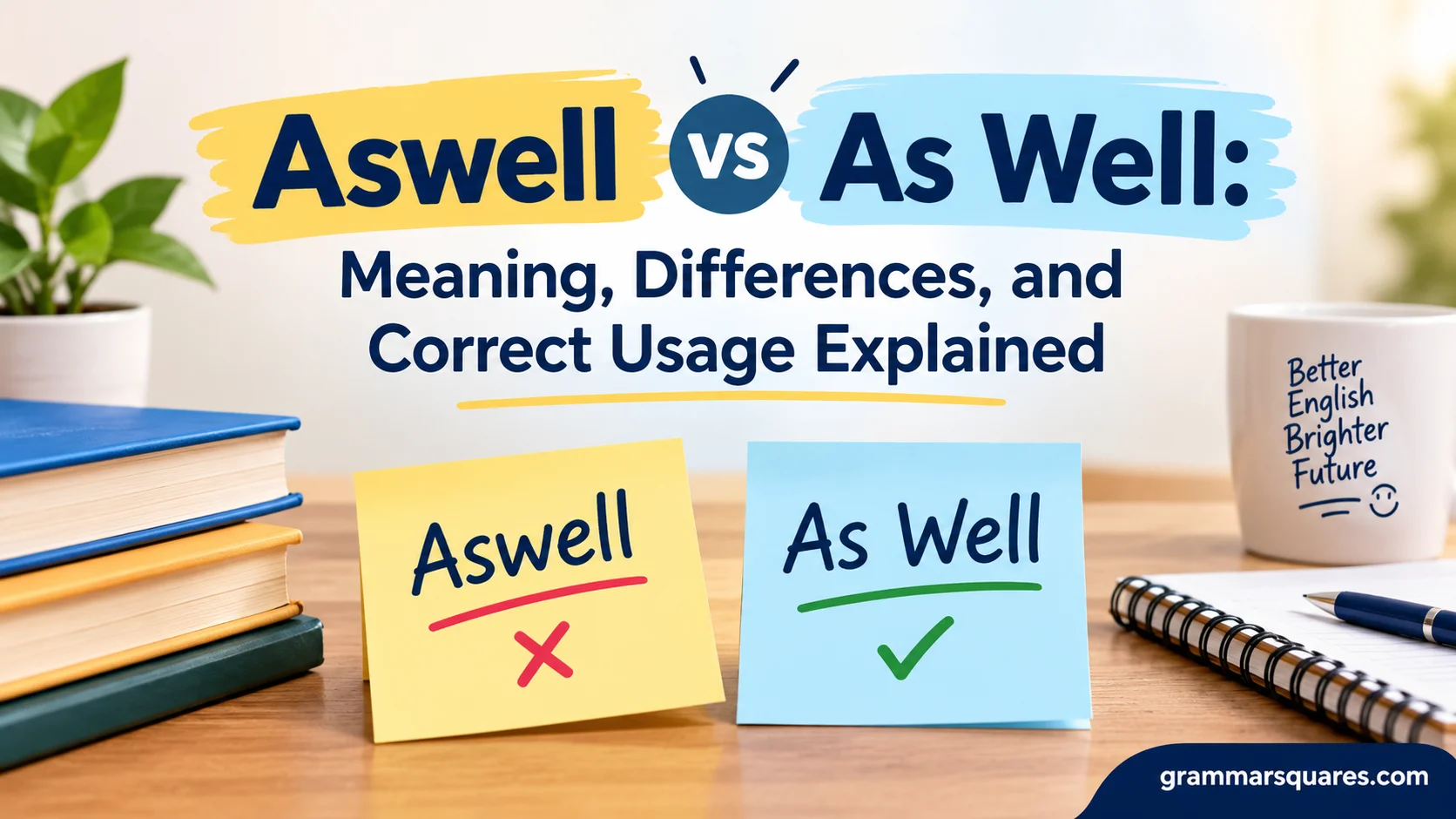

When you write in English, small spelling differences can sometimes create big confusion. One common example is “aswell” vs. “as well.” These two forms may look almost identical, but only one is considered correct in standard English. If you have ever wondered whether to write “aswell” or “as well” in an email, school assignment, or everyday message, you are not alone. Many English learners and even native speakers make this mistake because the words sound like a single expression when spoken aloud. Understanding this simple difference can help you improve your writing and communicate more clearly.
The phrase “as well” is a commonly used expression that means “also,” “too,” or “in addition.” You can use it in everyday conversations, professional emails, academic writing, and friendly messages. For example, you might say, “I would like to join you as well,” when you want to express that you also want to participate. Although the phrase contains two separate words, its meaning works together as one expression. On the other hand, “aswell” is generally considered a spelling mistake in standard English. Even though people sometimes type it online, especially in quick messages, it is not the accepted form for formal or correct writing.
Learning the difference between “aswell” and “as well” does not require complicated grammar rules. The most important thing to remember is that “as well” is always written as two words when you use it to mean “also” or “too.” Once you understand this rule, you can easily avoid a common spelling error in your daily communication. For example, writing “She speaks French as well” is correct, while “She speaks French aswell” is incorrect in standard English. Throughout this guide, you will discover the meaning, differences, examples, and correct usage of both forms, helping you feel more confident whenever you write in English.
Aswell vs As Well Meaning: Is “Aswell” a Word?
Let’s start with the simplest truth.
“Aswell” is not a standard English word.
English dictionaries like Oxford and Cambridge do not recognize it as valid. If you write it in formal writing, most grammar tools will flag it immediately.
What people usually mean is:
“as well” = in addition / also / too
The mistake happens because spoken English blends words together. When you say “as well” quickly, it sounds like one unit. So your brain treats it like a single word.
Quick breakdown
FormStatusMeaningExampleaswell❌ IncorrectNone (misspelling)“I want coffee aswell.”as well✅ Correctalso / in addition“I want coffee as well.”
Here’s the key idea: Meaning stays the same. Spacing changes correctness.
What “As Well” Actually Means in English
The phrase “as well” works as an additive expression. It expands an idea rather than changing it.
Think of it like adding an extra item to your shopping basket. You’re not replacing anything. You’re simply including more.
Core meanings
- Also
- In addition
- Too
Example usage in real sentences
- “She joined the meeting as well.”
- “I’ll take a sandwich as well.”
- “They agreed to help as well.”
Each sentence already makes sense without it. “As well” just adds extra information.
Why “As Well” Works Grammatically
Here’s where things get interesting.
“As well” is a phrasal adverbial expression. That means it modifies a sentence by adding extra meaning without changing grammar structure.
It often behaves like a flexible tag at the end of a sentence.
Common placement
- End of sentence: “I enjoyed the movie as well.”
- Mid-sentence (formal tone): “She as well agreed to the proposal.”
However, native speakers prefer the end position because it feels smoother and more natural.
Simple rule
Use “as well” to add information without interrupting sentence flow.
Why People Write “Aswell” (And Why It Keeps Happening)
If “aswell” is wrong, why do so many people still use it?
The answer is not ignorance. It’s language psychology + typing habits.
1. Spoken language influence
When spoken quickly, “as well” blends into a single sound:
/əzˈwɛl/
Your brain hears one unit, not two words.
2. Typing speed and autocorrect
On phones, speed matters. People often skip spacing rules when typing fast.
Example:
- “I will come as well” → becomes “I will come aswell”
Some keyboards even “learn” this mistake temporarily.
3. Influence of similar words
English already has many fused adverbs:
- anyway
- somehow
- anymore
- altogether
So your brain assumes “aswell” follows the same pattern.
4. Social media reinforcement
Short-form writing encourages speed over accuracy. Once enough people repeat the mistake, it starts to feel normal—even when it’s wrong.
As Well vs Similar English Expressions
Understanding Aswell vs As Well becomes easier when you compare it with similar words.
Let’s break it down clearly.
As well vs Also
FeatureAs wellAlsoToneConversationalNeutral / flexiblePositionUsually end of sentenceFlexible placementExample“I came as well.”“I also came.”
👉 Tip: Use “also” in formal writing. Use “as well” in natural speech.
As well vs Too
FeatureAs wellTooToneNeutralCasualCommon useEnd of sentenceEnd of sentenceExample“I want tea as well.”“I want tea too.”
👉 “Too” feels more emotional and conversational.
As well vs In addition
FeatureAs wellIn additionFormalityModerateHighUsageSpeech and writingAcademic / professionalExample“She attended as well.”“In addition, she attended.”
👉 “In addition” sounds structured and formal. “As well” feels smoother.
Common Mistakes with As Well
Even when people know the rule, mistakes still slip in. Here are the most frequent ones.
Writing it as one word
❌ “I’ll join you aswell.” ✅ “I’ll join you as well.”
Overusing it in formal writing
Too much repetition makes writing feel weak.
Example:
“The report covers marketing as well. It also includes sales data as well.”
Better:
“The report covers marketing. It also includes sales data.”
Misplacing it in awkward sentence positions
❌ “As well I want coffee.” ✅ “I want coffee as well.”
English prefers natural flow, not forced structure.
Confusing it with inversion structures
Some learners mistakenly think “as well” can replace “well as” in reversed phrases.
Example:
- Correct: “as well as” (different meaning entirely)
- Not interchangeable with: “as well”
As Well vs As Well As (Important Distinction)
This is where many learners get confused.
“As well”
Means:
- also
- in addition
Example:
- “I’ll come as well.”
“As well as”
Means:
- in addition to
- together with
Example:
- “She sings as well as dances.”
Key difference
PhraseMeaningExampleas wellalso“I’ll join as well.”as well asin addition to“I sing as well as dance.”
👉 One adds information. The other compares actions.
Simple Rules to Remember Aswell vs As Well
Here’s a clean set of rules you can rely on anytime.
- “Aswell” is always wrong
- “As well” always uses two words
- Use it to mean “also”
- Prefer end-of-sentence placement
- Use “also” for formal writing
- Use “too” for casual speech
If you forget everything else, remember this:
If it looks like one word, split it in two.
Read more : Maintained vs Maintenanced: Meaning, Differences?
Memory Tricks to Never Mix It Up Again
Let’s make this stick.
Trick 1: The “space equals correctness” rule
If you remove the space, the sentence breaks grammar rules.
Trick 2: The “addition box” analogy
Think of “as well” like adding another item to a box.
You don’t merge items into one object. You place them side by side.
Trick 3: Visual memory cue
- “aswell” ❌ = crammed, incorrect, messy
- “as well” ✅ = spaced, clean, correct
Real-World Case Study: Fixing Common Writing Errors
Let’s take a real-style example from informal writing.
Original text (incorrect usage)
“I will attend the meeting aswell. I will bring my notes aswell and share them after.”
This feels rushed and unpolished.
Step-by-step correction
- Fix spacing errors
- Reduce repetition
- Improve flow
Improved version
“I will attend the meeting as well. I will bring my notes and share them afterward.”
What changed?
IssueFix“aswell” spellingcorrected to “as well”repetitionreduced redundancysentence flowimproved readability
👉 Result: cleaner, more professional writing without changing meaning.
Quick Practice Examples (Correct vs Incorrect)
Try spotting the mistake:
- I want to come aswell. ❌
- I want to come as well. ✅
- She is joining us aswell. ❌
- She is joining us as well. ✅
- They agreed aswell. ❌
- They agreed as well. ✅
Now harder ones:
- I also want pizza aswell. ❌
- I also want pizza as well. ✅
Conclusion
Understanding the difference between “aswell” and “as well” is simple once you know the correct spelling. “As well” is the standard English expression meaning “also,” “too,” or “in addition.” It is always written as two separate words when used with this meaning. On the other hand, “aswell” is a common spelling mistake and is not accepted in standard English. Whether you are writing a professional email, a school assignment, or a casual message, always use “as well” to keep your writing clear, correct, and professional.
FAQs
1. Is “aswell” or “as well” correct?
“As well” is correct in standard English. “Aswell” is generally considered a spelling mistake.
2. What does “as well” mean?
“As well” means “also,” “too,” or “in addition.” It shows that something applies to another person or situation.
3. Is “aswell” one word or two?
The correct expression is written as two words: “as well.” Writing it as one word is incorrect in standard English.
4. Can I use “as well” in formal writing?
Yes, “as well” is appropriate for professional emails, academic assignments, and formal writing.
5. What is an example of “as well” in a sentence?
Example: “I would like to attend the meeting as well.” This means the speaker also wants to attend the meeting.




1 thought on “Aswell vs As Well: Meaning, Differences, and Correct Usage Explained”