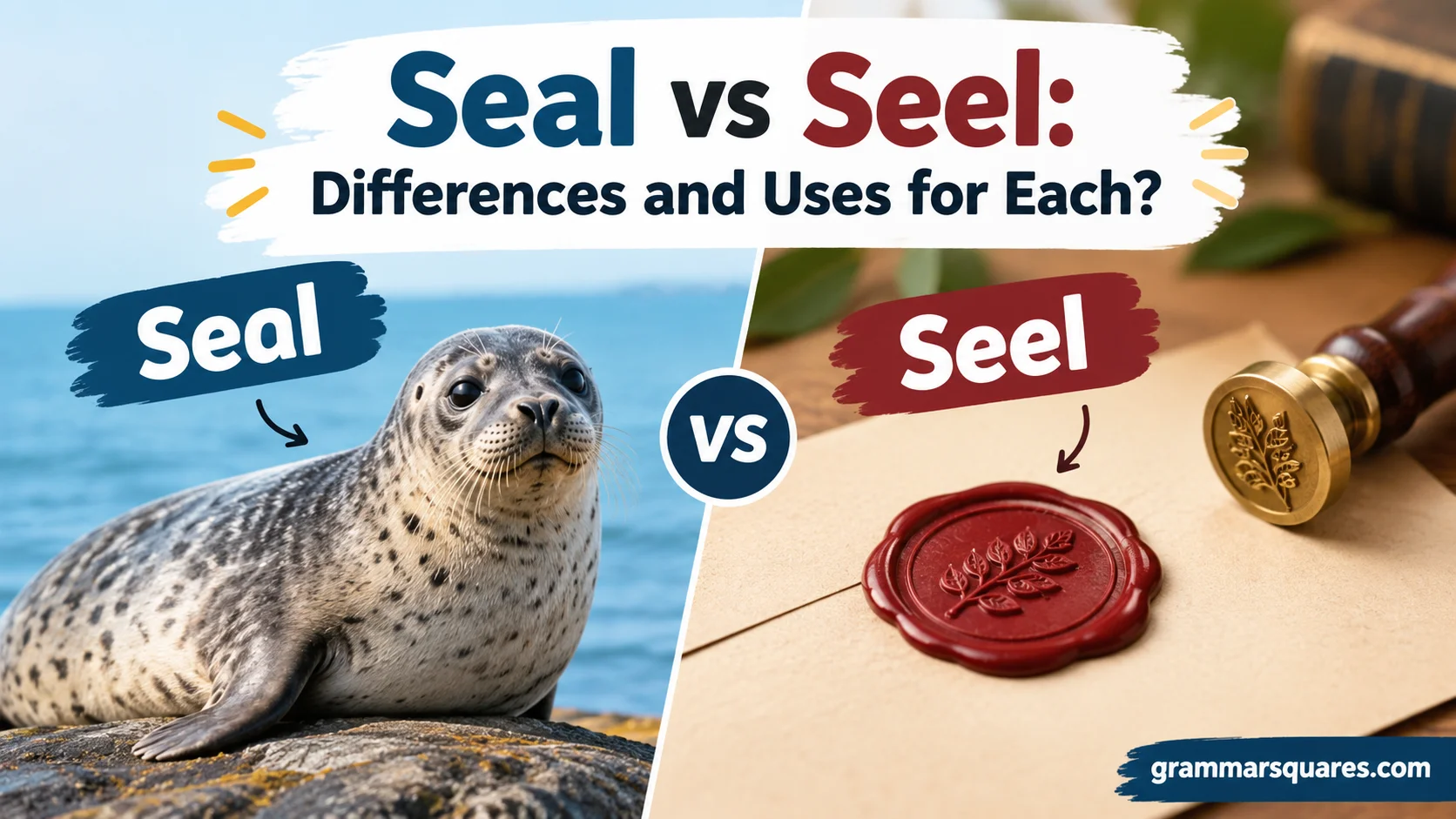

When learning English, Seal vs Seel can be confusing because these words sound similar but have very different meanings and uses. Seal is a common English word that can function as a noun or verb in everyday writing. It can describe an animal, a protective closure, or the action of closing something securely. Seel, on the other hand, is a much rarer word that appears mainly in specialized or historical contexts.
Understanding the difference between these two words can help you avoid spelling mistakes and choose the right word in your writing. Seal is widely used in daily conversation, business, science, and general English. For example, you might seal an envelope, seal a container, or talk about a seal swimming in the ocean. The word seel has a different history and is not normally used in modern everyday English. Knowing these differences makes correct word choice much easier.
The easiest way to remember Seal vs Seel is to focus on meaning, spelling, and context. Seal is the word you will need in most situations, while seel is uncommon and usually connected with older terminology or specific subjects. If you are writing an email, article, school assignment, or social media post, seal will generally be the correct choice when you mean to close securely or refer to the marine animal. Learning these distinctions can make your English writing clearer and more accurate.
Seal vs Seel: Why These Words Cause Confusion
At first glance, the confusion feels obvious. Both words:
- Look nearly identical
- Sound the same (/siːl/)
- Appear in older or unfamiliar writing contexts
But here’s the real issue: they belong to completely different usage worlds.
“Seal” is alive in modern English. You use it every day without noticing.
“Seel” is a linguistic fossil. It survives in historical writing and niche contexts like medieval falconry.
So when people mix them up, it usually comes from spelling similarity, not meaning overlap.
A simple way to think about it:
Seal = modern language you actively use Seel = historical language you rarely (if ever) need
What “Seal” Means in English Today
“Seal” is one of those flexible English words that does a lot of heavy lifting. It works as both a noun and a verb, and each role carries several meanings.
Seal as a Noun
A marine animal
A seal is a semi-aquatic marine mammal found in cold and temperate oceans.
Common species include:
- Harbor seal
- Elephant seal
- Leopard seal
These animals:
- Spend time on land and in water
- Have flippers instead of legs
- Hunt fish and squid
A quick example:
The seal rested on a rock before diving back into the water.
An official stamp or emblem
A seal also refers to a symbol used to authenticate documents.
Governments, institutions, and organizations use seals to:
- Validate documents
- Show authority
- Prevent forgery
Example:
The document carried the official seal of the court.
A closure device
You’ll also see “seal” used for physical closures.
Common examples include:
- Jar seals
- Envelope seals
- Waterproof seals
These prevent air, liquid, or contamination from entering.
Example:
The jar’s seal kept the sauce fresh for weeks.
Seal as a Verb
As a verb, “seal” becomes even more useful.
To close or fasten tightly
This is the most common modern use.
Examples:
- Seal a bag
- Seal a container
- Seal a package
She sealed the envelope before dropping it in the mailbox.
To finalize or confirm something
“Seal” often describes completion or agreement.
Examples:
- Seal a deal
- Seal a contract
- Seal an agreement
The handshake sealed the partnership between the two companies.
To secure emotionally or symbolically
Sometimes “seal” carries a figurative meaning.
His final goal sealed his legacy as a champion.
What “Seel” Means (Rare and Historical Usage)
Now we step into much older territory.
“Seel” is not part of modern everyday English. You won’t use it in emails, conversations, or business writing.
Instead, it appears in:
- Historical linguistics
- Medieval literature
- Falconry texts
The core meaning of “seel”
Historically, “seel” meant to stitch or close something shut, often referring to the eyes of birds in falconry practices.
Yes, it sounds intense, and it was.
Seel in falconry
In medieval falconry, handlers sometimes “seel” a hawk or falcon.
This involved:
- Partially sewing the bird’s eyelids
- Reducing visual stimulation
- Calming the bird during training
The goal wasn’t cruelty for its own sake in historical context. It aimed to control behavior during early training stages.
Example in historical writing:
The falconer seeled the hawk before beginning its training.
Modern relevance of “seel”
Today, you almost never encounter this word unless you are:
- Reading historical texts
- Studying linguistics
- Researching falconry history
In modern English, using “seel” outside these contexts looks incorrect.
Seal vs Seel: Core Differences Explained Clearly
Let’s strip away the complexity and compare them directly.
FeatureSealSeelModern usageVery commonExtremely rareWord typeNoun and verbVerb only (archaic)Meaning rangeAnimal, closure, authentication, completionTo sew or close shut (historical)Everyday useYesNoContextGeneral EnglishHistorical / specializedRisk of confusionLowHigh due to similarity
The biggest takeaway here is simple:
You will use seal constantly in daily life. You will almost never need seel.
Why “Seal” and “Seel” Sound the Same
Both words share the same pronunciation: /siːl/.
That creates a classic English trap: homophones or near-homophones in writing systems.
Here’s what causes the confusion:
- English pronunciation does not distinguish spelling here
- Listening doesn’t reveal spelling differences
- Typing becomes a guessing game
So your brain hears “seal” and assumes one spelling, even when historical texts use “seel.”
A useful analogy:
It’s like hearing two identical songs but finding out they were recorded on different instruments. Same sound, different origin.
Read more: Aswell vs As Well: Meaning, Differences, and Correct Usage Explained
Seal vs Seel in Real Sentences
Seeing the words in action makes the difference clearer.
Modern usage of Seal
- The technician sealed the leak in the pipe.
- The company sealed a multimillion-dollar contract.
- A seal swam gracefully near the iceberg.
- She sealed the letter with red wax for effect.
Historical usage of Seel
- The falconer seel the hawk before training began.
- Medieval texts describe how hunters would seel birds during transport.
Notice something important: “seel” almost always appears in past contexts, not modern life.
When to Use Seal vs Seel
Here’s a practical decision guide you can actually rely on.
Use “seal” when:
- Writing anything modern
- Referring to animals
- Talking about closing or securing something
- Discussing legal or official documents
- Using metaphorical language (seal the deal, seal the fate)
Avoid “seel” unless:
- You study medieval English
- You analyze falconry history
- You quote historical texts directly
A simple rule:
If your audience lives in the present, choose seal.
Common Mistakes People Make
Even confident writers slip up with these words.
Mistake: Using “seel” in modern writing
Wrong:
She seel the envelope before sending it.
Correct:
She sealed the envelope before sending it.
Mistake: Thinking they are interchangeable
They are not synonyms. They belong to different time periods.
Mistake: Overthinking spelling due to pronunciation
People often overcorrect and hesitate. But in reality, “seal” dominates modern English almost entirely.
Memory Tricks to Never Confuse Them Again
Let’s make this stick.
The “Modern vs Old” trick
- Seal = modern life (documents, animals, business deals)
- Seel = sealed away in history books
The “E” trick
- Seal = everyday English life
- Seel = ancient, extra “e” hiding in the past
The visualization trick
Picture this:
- A seal swimming in the ocean → active, modern, alive
- A seel written in a dusty medieval manuscript → old, forgotten
That contrast helps your brain lock it in.
Quick Reference Summary Table
CategorySealSeelUsage frequencyExtremely highExtremely lowMeaningMultiple modern meaningsOne historical meaningContextEveryday EnglishFalconry / medieval textsWriting needEssentialRare
Expert Insight: Why English Keeps Words Like “Seel”
Languages evolve slowly. Words like “seel” survive because:
- They appear in historical documents
- Scholars preserve them for accuracy
- Specialized fields keep them alive
Linguists often call these archaisms, meaning old forms that no longer serve everyday communication but remain useful in study.
In contrast, “seal” stayed active because it adapted. It gained new meanings over time and remained useful in modern contexts.
Conclusion
Understanding Seal vs Seel is important because these words have different meanings, uses, and levels of commonness. Seal is the standard and widely used English word. It can refer to a marine animal, a protective closure, or the action of closing something tightly or securely. You will commonly see it in everyday conversation, business writing, science, and general English.
Seel is a much less common word and is mainly found in specialized or historical contexts. Therefore, if you are talking about closing something, protecting an opening, or referring to the marine animal, seal is the correct spelling. Remembering the meaning and context of each word can help you write accurately and avoid unnecessary spelling mistakes.
FAQs
1. What is the difference between seal and seel?
Seal is a common English word with several meanings, while seel is a rare word used mainly in specialized or historical contexts.
2. Is seal the correct spelling for the animal?
Yes. Seal is the correct spelling for the marine mammal that lives in oceans and other bodies of water.
3. What does seal mean as a verb?
As a verb, seal means to close or secure something tightly, such as sealing an envelope or sealing a container.
4. Is seel commonly used in modern English?
No. Seel is uncommon in modern everyday English and generally appears in specific historical or specialized usage.
5. Which word should I use: seal or seel?
In most everyday situations, use seal. Use seel only when you specifically need its specialized or historical meaning.




1 thought on “Seal vs Seel: Differences and Uses for Each?”