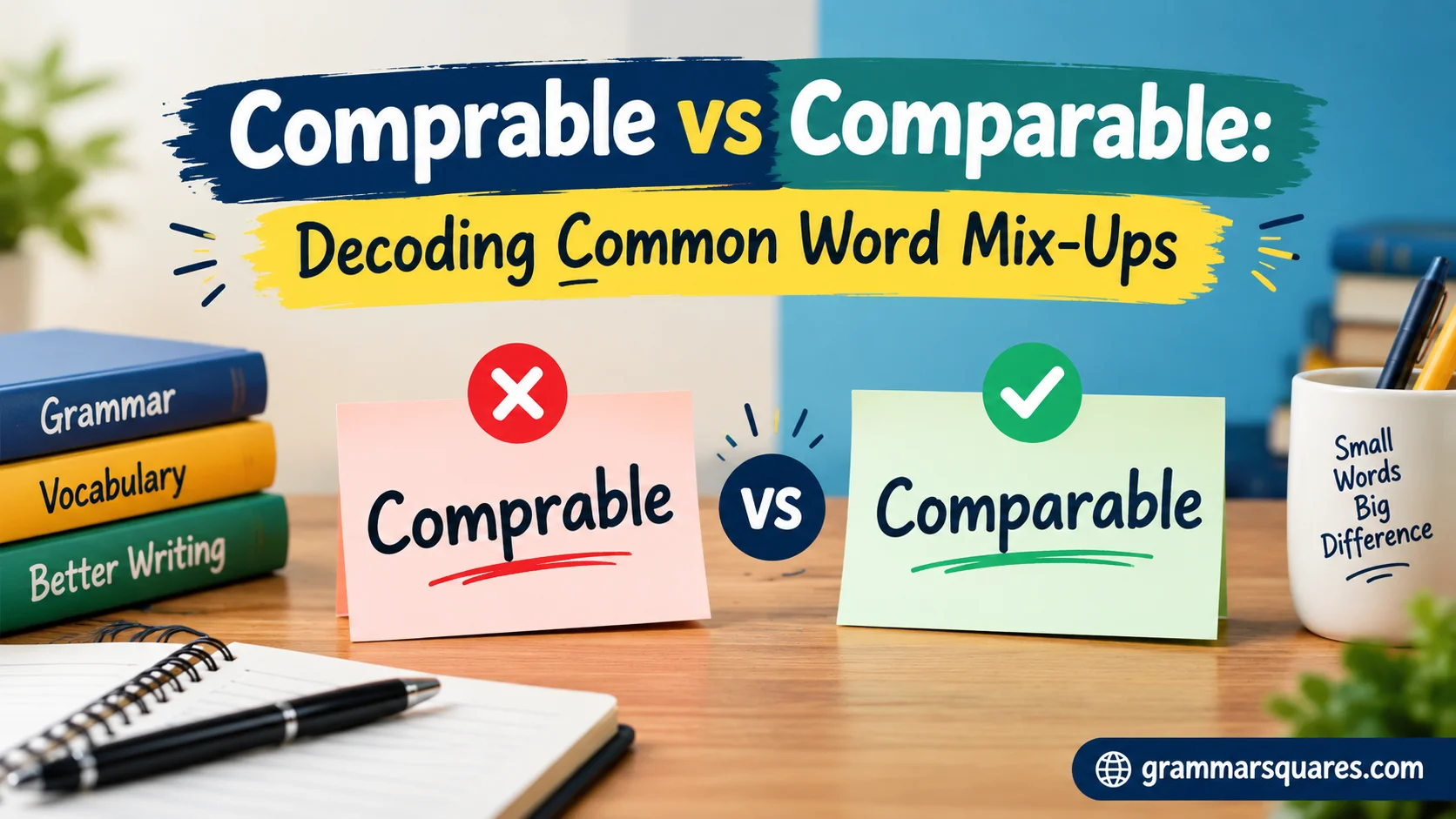

When it comes to English spelling, even small mistakes can create big confusion, especially with words that look almost identical. “Comprable” and “Comparable” are a common example of this spelling mix-up. While one form may seem correct at first glance, the other is the standard English spelling used in dictionaries and formal writing. Understanding the difference can help you avoid grammar mistakes, improve your writing skills, and communicate your ideas more clearly. This guide will explain which spelling is correct and why the confusion happens.
The word “Comparable” is the correct spelling when you want to describe two things that can be compared because they share similar qualities, features, or characteristics. The spelling “Comprable” is generally considered a misspelling and should be avoided in professional writing, academic work, and everyday communication. The confusion often happens because people naturally try to shorten the word when pronouncing or spelling it. Learning the correct form becomes much easier when you understand its meaning, pronunciation, and connection to the word “compare.”
Knowing when to use Comparable can make your sentences sound more accurate, natural, and professional. For example, you might say that two products have comparable prices, or that two athletes have comparable skills. Once you recognize the correct spelling, you’ll be less likely to write “Comprable” by mistake. In this article, we’ll explore the meaning, spelling, pronunciation, usage, and common mistakes associated with these words. By the end, you’ll know exactly which word to choose and how to use it confidently in different situations.
Comprable vs Comparable: The Quick Answer
If you’re looking for the short answer, here it is:
| Word | Correct? | Meaning |
| Comparable | ✅ Yes | Able to be compared; similar enough for comparison |
| Comprable | ❌ No | Misspelling of comparable |
The word comparable is recognized by all major English dictionaries and style guides.
The spelling comprable is not considered a standard English word.
Examples
✅ Correct:
- The two products are comparable in quality.
- Their salaries are comparable to industry standards.
- The results are comparable across multiple studies.
❌ Incorrect:
- The products are comprable in quality.
- The results are comprable across studies.
What Does Comparable Mean?
The word comparable is an adjective.
It describes things that are similar enough to be compared or evaluated against one another.
Dictionary Definition
Comparable means:
“Capable of being compared; similar in important respects.”
In other words, two things do not need to be identical to be comparable. They simply need to share enough characteristics to make a meaningful comparison possible.
Pronunciation of Comparable
Most speakers pronounce comparable as:
COM-puh-ruh-bul
or
KOM-pruh-bul
Notice something important?
The middle syllable often becomes weak or reduced during speech. This is one reason people mistakenly write comprable instead of comparable.
Examples of Comparable in Sentences
Business
- The company’s revenue is comparable to that of its competitors.
- Our pricing is comparable with leading brands.
Education
- Test scores remained comparable across different schools.
- Student performance was comparable between both groups.
Everyday Use
- The two smartphones offer comparable features.
- Their houses are comparable in size.
Is Comprable a Real Word?
The simple answer is:
No.
The spelling comprable does not appear in standard English dictionaries.
It is considered a spelling error rather than an alternative spelling.
Major Dictionaries Recognize Comparable
The following dictionaries include comparable:
- Merriam-Webster
- Cambridge Dictionary
- Oxford English Dictionary
- Collins Dictionary
- Dictionary.com
None recognize comprable as a standard word.
Why Does Comprable Appear Online?
If it is wrong, why do you see it online?
There are several reasons:
Typing Errors
People type quickly and accidentally omit letters.
Pronunciation Influence
The middle syllable is often weakly pronounced.
User-Generated Content
Forums, blogs, social media posts, and comments frequently contain spelling mistakes.
Search Engine Queries
Many users search for “comprable” because they are unsure of the correct spelling.
The appearance of a word online does not necessarily make it correct.
Why the Confusion Happens
Understanding the source of the mistake can help prevent it.
Spoken English Often Hides Letters
Many English words lose syllables during casual speech.
For example:
| Written Form | Common Spoken Form |
| Comfortable | Comf-ter-ble |
| Vegetable | Veg-ta-ble |
| Different | Dif-rent |
| Comparable | Comp-ra-ble |
Notice how syllables disappear or become compressed.
When writers rely on sound alone, spelling errors become more likely.
The Missing “A” Problem
The most common mistake is dropping the letter a after “par.”
Correct:
Comparable
Incorrect:
Comprable
Since the “a” is lightly pronounced, many people forget it exists.
Pattern Recognition Errors
Human brains naturally look for shortcuts.
A writer may see:
- comparable
- comparable
- comparable
But mentally simplify it to:
- comprable
This happens because the brain prioritizes pronunciation over spelling.
Understanding the Structure of Comparable
One of the easiest ways to remember the correct spelling is to understand its construction.
Word Breakdown
The word comes from:
Compare + Able = Comparable
| Part | Meaning |
| Compare | Examine similarities and differences |
| -able | Capable of being |
Together they form:
Comparable = capable of being compared
Why This Matters
Whenever you forget the spelling, ask yourself:
“What is the base word?”
The answer is compare.
Since the root word contains the “a,” the correct spelling remains:
Comparable
not
Comprable
How to Use Comparable Correctly
Understanding grammar is just as important as spelling.
Comparable Is an Adjective
It describes a noun.
Examples:
- Comparable products
- Comparable prices
- Comparable experiences
- Comparable outcomes
Common Sentence Structures
Comparable To
Used frequently in American English.
Examples:
- Their salaries are comparable to ours.
- The new model is comparable to last year’s version.
Comparable With
More common in some formal and British contexts.
Examples:
- These figures are comparable with previous reports.
- The findings are comparable with earlier research.
Comparable In
Used when discussing a specific characteristic.
Examples:
- Comparable in size
- Comparable in quality
- Comparable in value
- Comparable in performance
Read More: Realist vs Realest: What’s the Difference?
Comparable vs Similar: What’s the Difference?
Many writers use these words interchangeably, but they are not exactly the same.
| Comparable | Similar |
| Suitable for comparison | Resembling something |
| Focuses on comparison | Focuses on likeness |
| May contain differences | Usually emphasizes similarities |
Example
Comparable
- The two vehicles are comparable in price.
This means a comparison can reasonably be made.
Similar
- The two vehicles are similar in appearance.
This means they look alike.
The distinction is subtle but important.
Comparable vs Compareable
Another common spelling mistake is compareable.
Why It Happens
People assume the word should simply be:
Compare + able
which would seem to create:
Compareable
However, English spelling rules often drop the final “e” before adding “-able.”
Examples
| Base Word | Correct Form |
| Compare | Comparable |
| Value | Valuable |
| Desire | Desirable |
| Admire | Admirable |
The silent “e” disappears.
Therefore:
❌ Compareable
✅ Comparable
Common Phrases That Use Comparable
You will encounter comparable frequently in professional communication.
Business
- Comparable pricing
- Comparable products
- Comparable performance
- Comparable value
Finance
- Comparable earnings
- Comparable revenue
- Comparable assets
Real Estate
- Comparable sales
- Comparable homes
- Comparable properties
Research
- Comparable findings
- Comparable results
- Comparable studies
Real-World Applications of Comparable
The word is especially important in several industries.
Comparable in Business
Businesses compare performance metrics regularly.
Examples include:
- Revenue
- Profit margins
- Customer retention
- Conversion rates
Example
A company earning $10 million annually may compare itself with competitors earning between $8 million and $12 million.
These businesses are considered comparable companies.
Comparable in Real Estate
Real estate professionals often use the term:
Comps
“Comps” means comparable properties.
Agents examine:
- Square footage
- Number of bedrooms
- Neighborhood
- Property condition
- Sale date
Case Study: House Valuation
A homeowner wants to sell a property.
Instead of guessing a price, the agent reviews:
| Property | Sold Price |
| House A | $295,000 |
| House B | $305,000 |
| House C | $300,000 |
Because these homes are comparable, the seller can estimate a reasonable listing price.
Comparable in Academic Research
Researchers often compare datasets.
For meaningful analysis:
- Sample sizes should be similar.
- Measurement methods should match.
- Conditions should remain consistent.
Without comparable data, conclusions become unreliable.
Comparable in Healthcare
Healthcare studies frequently compare:
- Treatments
- Medications
- Recovery rates
- Patient outcomes
Researchers strive to create comparable groups to ensure accurate findings.
Common Mistakes Writers Make With Comparable
Even experienced writers make errors.
Misspelling the Word
Examples:
❌ Comprable
❌ Compareable
✅ Comparable
Using It Where Similar Is Better
Incorrect:
- Their personalities are comparable.
Better:
- Their personalities are similar.
While not always wrong, “similar” often sounds more natural.
Comparing Unrelated Things
Poor comparison:
- The weather is comparable to mathematics.
These subjects share no meaningful basis for comparison.
Strong comparison:
- This year’s weather is comparable to last year’s.
Memory Tricks to Avoid Writing Comprable
Spelling becomes easier when you use memory techniques.
The Compare + Able Rule
Always think:
Compare + Able = Comparable
This instantly reminds you that the “a” belongs in the word.
Visual Breakdown
COM + PAR + ABLE
Notice the hidden A in the middle.
Many writers mentally picture the word as three separate chunks.
The Root Word Method
Ask yourself:
“What word is hiding inside?”
The answer:
Compare
Because compare contains the letter “a,” comparable must contain it too.
Proofreading Strategy
Before publishing important documents:
Check For
- Comprable
- Compareable
- Compairable
- Comparible
Replace With
- Comparable
A simple search-and-replace review can eliminate errors quickly.
Expert Writing Tips for Using Comparable Effectively
Professional writers use comparable carefully.
Be Specific
Weak:
- The products are comparable.
Strong:
- The products are comparable in durability and performance.
Specific comparisons provide greater clarity.
Support Comparisons With Data
Instead of:
- Sales are comparable.
Write:
- Sales increased 8%, which is comparable to last year’s 7.5% growth.
Numbers strengthen credibility.
Avoid Vague Comparisons
Readers need context.
Ask:
- Comparable in what way?
- Comparable to what?
- Comparable under which conditions?
Answering these questions improves writing quality.
Frequently Used Comparable Expressions
Here are some phrases commonly seen in professional writing.
| Phrase | Meaning |
| Comparable value | Similar worth |
| Comparable performance | Similar results |
| Comparable products | Similar products |
| Comparable quality | Similar standard |
| Comparable experience | Similar level of expertise |
| Comparable prices | Similar costs |
Commonly Confused Words Related to Comparable
English contains many similar word mix-ups.
| Incorrect Form | Correct Form |
| Comprable | Comparable |
| Compareable | Comparable |
| Definately | Definitely |
| Seperate | Separate |
| Occured | Occurred |
| Recieve | Receive |
Learning these patterns improves overall writing accuracy.
The Importance of Correct Spelling in Professional Writing
Spelling mistakes affect credibility.
Studies consistently show that readers judge professionalism based partly on grammar and spelling quality.
A single mistake like comprable may seem minor, but it can influence:
- Job applications
- Academic papers
- Marketing materials
- Business reports
- Website content
Correct spelling demonstrates attention to detail.
Quick Reference Table
| Question | Answer |
| Is comparable a real word? | Yes |
| Is comprable a real word? | No |
| Is compareable correct? | No |
| What part of speech is comparable? | Adjective |
| What does comparable mean? | Able to be compared |
| How do you remember it? | Compare + able |
FAQs:
Is comprable a word?
No. Comprable is not recognized as a standard English word. It is considered a misspelling of comparable.
What is the correct spelling: comprable or comparable?
The correct spelling is comparable.
Why do people write comprable?
Most people omit the letter “a” because the middle syllable is often weakly pronounced in everyday speech.
Is compareable correct?
No. The correct spelling is comparable because the final “e” in compare is dropped before adding the suffix -able.
What does comparable mean?
Comparable means able to be compared or similar enough to make a meaningful comparison.
Conclusion
The debate between comprable vs comparable has a clear winner: comparable is the correct spelling, while comprable is simply a common misspelling. The confusion usually arises because spoken English often compresses syllables, causing writers to accidentally omit the letter.This word is widely used across business, finance, real estate, research, education, and everyday communication to describe things that can be meaningfully compared. By understanding its origin, grammar, and proper usage, you can avoid a frequent spelling mistake and write with greater confidence and professionalism.



1 thought on “Comprable vs Comparable: Decoding Common Word Mix-Ups”