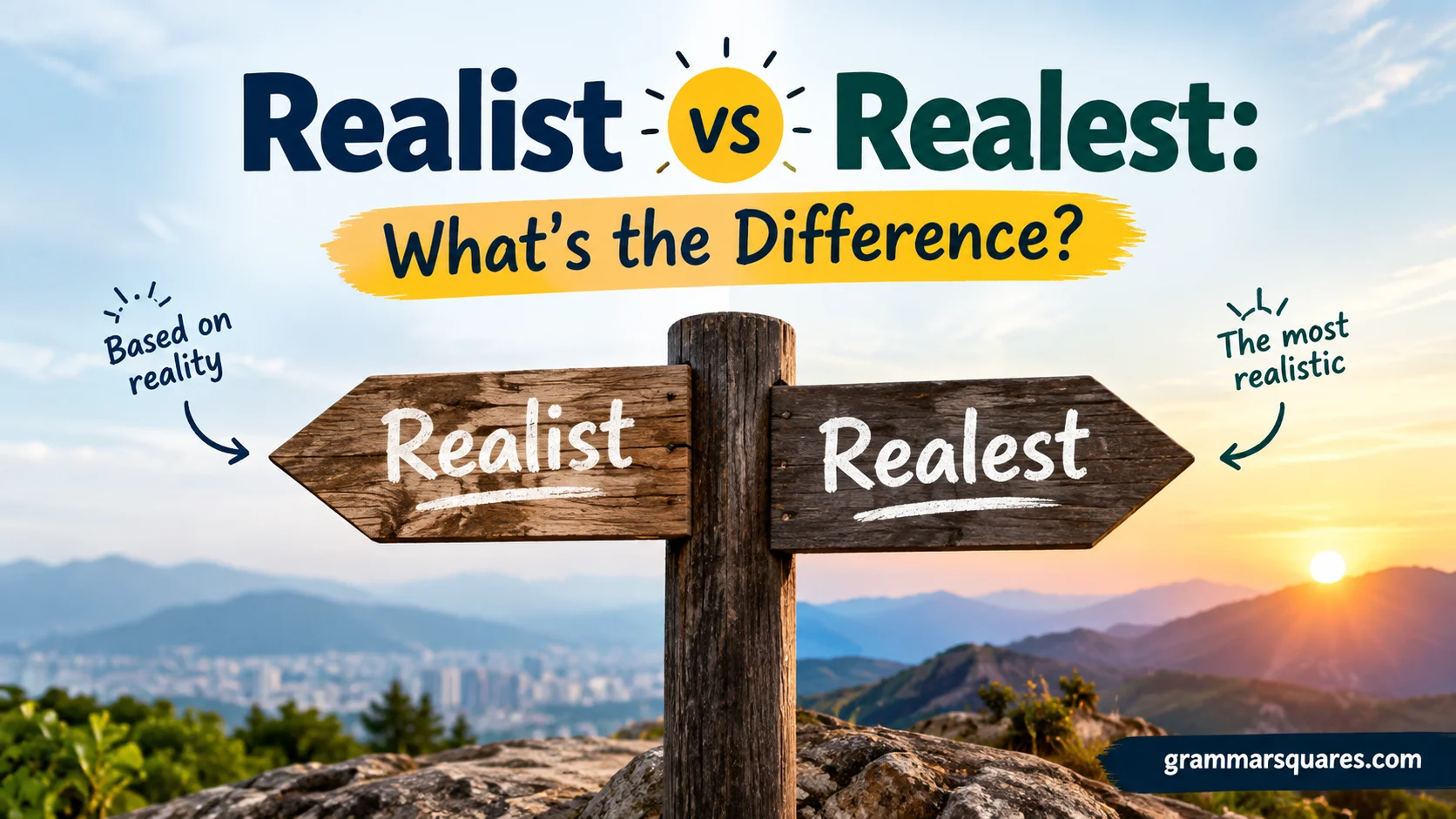

When learning English vocabulary, some words can seem very similar but have completely different meanings. The words realist and realest are a good example because they both come from the word real. A realist is a person who looks at life practically and accepts things as they really are. On the other hand, realest is used to describe something that feels extremely real, genuine, or completely authentic. Understanding this key difference can help you avoid common grammar mistakes. It also makes your writing clearer, more natural, and easier for readers to understand. Whether you’re writing an essay, article, message, or social media post, using the correct word matters.
The word realist is usually a noun that refers to a person with a practical view of life and situations. A realist usually focuses on facts, reality, and possibilities instead of expecting everything to be perfect or ideal. For example, someone who understands that a difficult goal requires time and effort may be called a realist. The word realest, however, is a superlative form of “real” and is often used in informal English. It can describe something that seems very genuine, honest, or authentic compared with other things. You may see realest in casual conversations, captions, comments, and social media posts. Knowing how each word functions will make your English usage more accurate and confident.
Although realist and realest share the same root word, their grammatical roles and meanings are quite different. You should use realist when talking about a person who accepts reality and thinks in a practical way. You can use realest when emphasizing that something feels especially real or genuine in a particular situation. For example, “She is a realist” describes someone’s personality, while “That was the realest moment” describes an experience. In formal writing, phrases such as “most real” may sometimes sound more natural than “realest.” However, realest is common in casual and expressive language. Once you understand this simple distinction, choosing between the two words becomes much easier and clearer.
Realist vs. Realest: The Quick Answer
The easiest way to understand the difference is this:
| Word | Part of Speech | Meaning |
| Realist | Noun | A person who sees and accepts reality as it is |
| Realest | Adjective | The most genuine, authentic, or honest |
Example
Realist:
Sarah is a realist who carefully evaluates risks before making decisions.
Realest:
Sarah is the realest friend I’ve ever had.
Notice the difference:
- In the first sentence, realist refers to a person’s mindset.
- In the second sentence, realest describes a quality.
This distinction is the foundation of understanding realist vs. realest.
What Does “Realist” Mean?
A realist is someone who accepts reality and bases decisions on facts rather than wishes, fantasies, or unrealistic expectations.
The word comes from realism, a philosophical and intellectual tradition that emphasizes objective reality.
Dictionary Meaning
A realist is:
A person who recognizes and accepts situations as they actually are.
In everyday life, a realist focuses on what is practical and achievable.
Characteristics of a Realist
Most realists share several qualities:
- Fact-oriented thinking
- Practical decision-making
- Rational judgment
- Objective analysis
- Awareness of limitations
- Preference for evidence over assumptions
Example Sentences
- He is a realist who understands market risks.
- As a realist, she prepared multiple backup plans.
- The investor remained a realist despite optimistic forecasts.
- A realist evaluates both opportunities and dangers.
Realists in Everyday Life
Being a realist doesn’t mean being negative.
Many people confuse realism with pessimism.
Realist vs. Pessimist
| Realist | Pessimist |
| Accepts facts | Expects negative outcomes |
| Focuses on reality | Focuses on problems |
| Balances risks and opportunities | Often emphasizes risks |
| Practical thinker | Often overly cautious |
For example:
A realist might say:
“Starting a business is challenging, but with proper planning it can succeed.”
A pessimist might say:
“Most businesses fail, so there’s no point trying.”
The realist acknowledges challenges without assuming failure.
What Does “Realest” Mean?
Realest is the superlative form of the adjective real.
It means:
- Most authentic
- Most genuine
- Most honest
- Most sincere
- Most true to reality
Basic Grammar
| Form | Word |
| Positive | Real |
| Comparative | Realer |
| Superlative | Realest |
Examples:
- This story is real.
- That story is realer than the rumor.
- This is the realest account of what happened.
Although realer and realest are grammatically correct, native speakers often use:
- More real
- Most real
depending on context.
Modern Meaning of Realest
In modern English, particularly in informal speech, realest often means:
- Most trustworthy
- Most loyal
- Most authentic
- Most honest
Examples
- She’s the realest friend I know.
- He gave me the realest advice.
- That interview showed the realest side of the celebrity.
- This documentary offers the realest portrayal of the event.
In these examples, realest emphasizes authenticity rather than literal reality.
Realist vs. Realest: Side-by-Side Comparison
The following table highlights the most important differences.
| Feature | Realist | Realest |
| Part of Speech | Noun | Adjective |
| Refers To | A person | A quality |
| Meaning | Someone who accepts reality | Most authentic or genuine |
| Formal Usage | Common | Less common |
| Informal Usage | Common | Very common |
| Academic Writing | Frequently used | Rarely used |
| Describes People | Yes | Yes |
| Describes Things | No | Yes |
Key Insight
A person can be both:
A realist and the realest person in the room.
The first word describes their outlook.
The second describes their authenticity.
Understanding Realist in Philosophy
The word realist has deep roots in philosophy.
Philosophical realism argues that reality exists independently of human perception.
In simple terms:
Things exist whether we observe them or not.
For example:
A mountain exists even if nobody is looking at it.
This idea forms the basis of realism.
Major Types of Philosophical Realism
Metaphysical Realism
Metaphysical realism argues that an objective reality exists independently of human thoughts.
Key belief:
- Reality is not created by our minds.
Scientific Realism
Scientific realists believe scientific theories describe actual aspects of the world.
Examples include:
- Gravity
- Atoms
- Electrons
Even though we cannot directly see some of these phenomena, scientific realists believe they truly exist.
Moral Realism
Moral realism suggests that objective moral truths exist.
Examples:
- Murder is wrong.
- Honesty is good.
According to moral realists, these truths are not merely personal opinions.
Direct Realism
Direct realism states that humans perceive the world directly rather than through mental representations.
Realist in Art and Literature
Another important meaning of realist appears in art and literature.
A realist artist or writer seeks to represent life accurately.
Characteristics of Realist Art
Realist art typically includes:
- Everyday subjects
- Ordinary people
- Accurate details
- Natural settings
- Minimal idealization
Realist artists portray life as it actually appears.
Characteristics of Realist Literature
Realist literature focuses on:
- Everyday experiences
- Social conditions
- Human behavior
- Realistic dialogue
- Complex characters
Instead of fairy tales or fantasy worlds, realist writers depict ordinary life.
Famous Realist Writers
Some of history’s most influential realist writers include:
- Leo Tolstoy
- Gustave Flaubert
- Honoré de Balzac
- Charles Dickens
Their works continue to shape modern literature.
Why “Realest” Became Popular in Modern English
The popularity of realest increased dramatically through music, social media, and popular culture.
In modern speech, authenticity is highly valued.
People frequently use phrases such as:
- The realest friend
- The realest person
- The realest conversation
- The realest advice
Influence of Social Media
Platforms like:
- TikTok
- X
have contributed to the widespread use of realest.
Users often praise people who appear honest and authentic.
Traditional vs. Modern Meaning
| Traditional Meaning | Modern Meaning |
| Most genuine | Most loyal |
| Most authentic | Most trustworthy |
| Most realistic | Most relatable |
| Most true | Most honest |
Language evolves, and realest reflects changing cultural values.
Grammar Rules for Using Realist and Realest Correctly
Understanding grammar helps eliminate confusion.
When to Use Realist
Use realist when referring to:
- A person’s mindset
- Philosophy
- Practical thinking
- Realism in art
- Realism in literature
Examples
- She is a realist.
- The realist considered all possible outcomes.
- Many investors are realists.
When to Use Realest
Use realest when describing:
- Authenticity
- Honesty
- Genuineness
- Loyalty
Examples
- He is the realest friend I have.
- That was the realest conversation of my life.
- This book provides the realest depiction of poverty.
Easy Grammar Formula
Remember this:
Realist = Person
Realest = Most Authentic
This simple rule solves most usage problems.
Common Mistakes Writers Make
Even experienced writers occasionally misuse these words.
Mistake: Using Realest as a Noun
Incorrect:
He is a realest.
Correct:
He is the realest person here.
Why?
Because realest is an adjective, not a noun.
Mistake: Using Realist as an Adjective
Incorrect:
She gave a realist answer.
Correct:
She gave a realistic answer.
Here, realistic is needed because you’re describing the answer.
Read More: Dought vs Doubt: Which Should You Use in Writing?
Mistake: Confusing Realist and Realistic
This is one of the most common grammar errors.
Comparison Table
| Word | Part of Speech | Meaning |
| Realist | Noun | Practical person |
| Realistic | Adjective | Practical or achievable |
| Realest | Adjective | Most authentic |
Examples:
- John is a realist.
- John’s expectations are realistic.
- John is the realest person on the team.
Realist vs. Realistic vs. Realest
Many learners confuse all three terms.
Here’s a deeper comparison.
| Word | Meaning | Example |
| Realist | Person accepting reality | She is a realist. |
| Realistic | Practical and achievable | That’s a realistic goal. |
| Realest | Most authentic | He’s the realest friend. |
Understanding the Relationship
Think of it this way:
- A realist is a person.
- Realistic describes practicality.
- Realest describes authenticity.
Example
A realist sets realistic goals and often becomes the realest voice in difficult situations.
This sentence correctly uses all three words.
Synonyms and Related Words
Understanding synonyms helps expand vocabulary.
Synonyms for Realist
- Pragmatist
- Rational thinker
- Practical thinker
- Objectivist
- Evidence-based thinker
Example
A pragmatist and a realist often approach problems similarly.
Synonyms for Realest
- Most authentic
- Most genuine
- Most sincere
- Most honest
- Most trustworthy
Example
“The realest friend” could also mean:
The most trustworthy friend.
Related Words
| Word | Meaning |
| Reality | Actual state of things |
| Realism | Philosophy or artistic movement |
| Realistic | Practical |
| Realistically | In a practical way |
| Realness | Authenticity |
These words belong to the same word family but serve different grammatical roles.
Real-World Examples From Everyday English
Understanding theory is helpful, but seeing real-life usage is even better.
Workplace Example
Manager:
We need to be realistic about our budget.
Employee:
As a realist, I think we should reduce expenses.
Here:
- Realistic describes the budget assessment.
- Realist describes the employee.
Academic Example
Professor:
Scientific realists believe scientific theories reflect reality.
In this case:
- Realists refers to supporters of scientific realism.
Friendship Example
She stayed by my side during the hardest years of my life. She’s the realest friend I know.
Here:
- Realest means loyal and genuine.
Business Example
A successful entrepreneur often combines:
- Realist thinking
- Realistic planning
- Real authenticity
This combination builds credibility and trust.
Famous Quotes About Realism and Authenticity
Here are some thought-provoking observations that reflect the spirit of realism and authenticity.
“Face reality as it is, not as it was or as you wish it to be.”
“Authenticity is the daily practice of letting go of who we think we’re supposed to be.”
“A realist sees obstacles, but also sees solutions.”
These ideas capture the essence of both realist and realest.
Practice Quiz: Can You Choose the Correct Word?
Question 1
She is a ______ who evaluates evidence carefully.
A. Realest
B. Realist
Answer: B. Realist
Question 2
He’s the ______ friend I’ve ever had.
A. Realist
B. Realest
Answer: B. Realest
Question 3
That’s a very ______ plan.
A. Realistic
B. Realest
Answer: A. Realistic
Question 4
Many philosophers identify as ______.
A. Realists
B. Realests
Answer: A. Realists
Question 5
That documentary offered the ______ depiction of the event.
A. Realest
B. Realist
Answer: A. Realest
FAQs:
Is realest a real word?
Yes. Realest is the superlative form of real. It means the most genuine, authentic, honest, or true.
Can a person be both a realist and the realest?
Yes. Someone can be a realist because they accept reality and also be considered the realest person because they are authentic and trustworthy.
What is the difference between realist and realistic?
A realist is a person, while realistic is an adjective describing something practical, achievable, or grounded in reality.
Is realest formal or informal English?
Realest is grammatically correct but appears more frequently in informal speech, social media, music, and everyday conversation than in academic writing.
Which word is more common in academic writing?
Realist is significantly more common in academic writing because it is widely used in philosophy, politics, economics, literature, and social sciences.
Conclusion
Understanding realist vs. realest is easier once you recognize that these words serve completely different grammatical and semantic functions. A realist is a person who approaches life with practicality, logic, and an acceptance of reality, while realest is a descriptive term used to identify the most authentic, genuine, honest, or trustworthy person or thing in a group.
Although both words originate from the root word real, they are not interchangeable. Using realist correctly helps you discuss mindsets, philosophies, and practical thinking, whereas realest is best used when emphasizing authenticity and sincerity. It’s also important to distinguish these words from realistic, which describes something achievable or grounded in reality.




1 thought on “Realist vs Realest: What’s the Difference?”