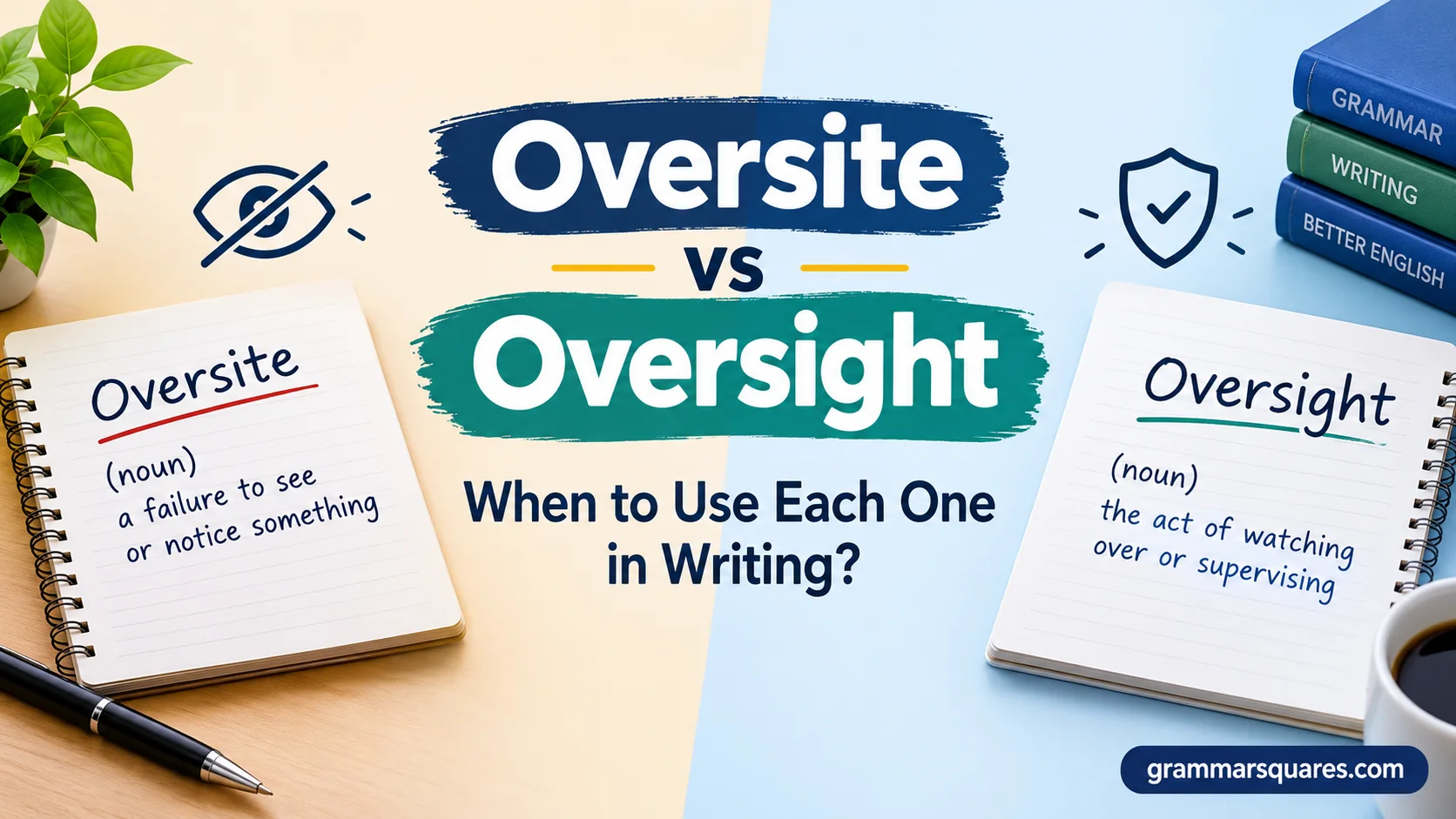

When writing in English, similar-looking words can easily create confusion, especially when they have different meanings or uses. Oversite and oversight are a good example because they look almost identical at first glance. However, these two terms have different meanings, and one is far more common in everyday writing. Knowing the difference can help you avoid spelling mistakes, choose the right word, and make your writing sound more accurate and professional.
The word oversight is a standard English word with two main meanings. It can refer to supervision, monitoring, or the responsibility of watching over something. It can also describe an unintentional mistake, such as forgetting something important. Because of these meanings, you may see oversight in professional emails, workplace documents, academic writing, and everyday conversations. Understanding the context is important because the same word can describe either careful supervision or an accidental omission.
In contrast, oversite is much less common and is generally considered a specialized term rather than a normal replacement for oversight. It may appear in specific technical contexts, especially when referring to a site or location, but it should not be used simply because it looks like another spelling of oversight. If you are trying to say supervision or an unintentional mistake, the correct choice is oversight. In this guide, we’ll explain the meaning, usage, examples, and key differences between both terms.
Oversite vs Oversight: The Quick Answer You Can Rely On
If you only remember one thing from this entire article, make it this:
- Oversight = correct word (supervision OR mistake/omission)
- Oversite = usually a misspelling, except in rare construction contexts
That’s it. No ambiguity needed for most writing situations.
To make it even clearer:
WordStatus in Modern EnglishMeaningShould You Use It?OversightStandard English wordSupervision OR mistakeYesOversiteRare technical term or typoConstruction layer OR incorrect spellingNo (almost always)
Most confusion disappears once you accept this baseline rule.
What “Oversight” Means in Real Writing
The word oversight has two distinct meanings, and both are widely accepted in English.
What makes it tricky is that the meanings feel unrelated, yet they share the same spelling.
Oversight as Supervision or Authority
In professional, legal, or organizational contexts, oversight means monitoring, supervision, or control.
Think of it as someone “watching over” a process to make sure it stays on track.
Examples:
- The board provides oversight of company operations.
- Government oversight ensures safety regulations are followed.
- The project manager handles oversight of all development tasks.
In this sense, oversight usually implies responsibility, authority, and accountability.
A simple way to remember it:
Oversight = someone is “watching over” something important.
Oversight as a Mistake or Omission
The second meaning is very different. Here, oversight refers to an unintentional error or something missed.
This usage is extremely common in everyday writing.
Examples:
- The missing signature was an oversight.
- The error happened due to a clerical oversight.
- We apologize for the oversight in your invoice.
In this case, no one is actively supervising anything. Instead, something slipped through the cracks.
A helpful mental shortcut:
Oversight = something was accidentally overlooked.
Why One Word Has Two Meanings
English often reuses words based on historical development. “Oversight” evolved from the idea of “seeing over” something.
From that core idea, two meanings emerged:
- Watching over something (supervision)
- Failing to notice something (error)
It’s a perfect example of how language grows in two directions at once.
What “Oversite” Really Is (And Why It Confuses So Many People)
Now let’s talk about the troublemaker: oversite.
Most writers assume it’s a valid alternative spelling. It’s not, in standard English usage.
In most cases, “oversite” appears because of:
- Typing mistakes (very common)
- Autocorrect errors
- Mishearing “oversight”
- Confusion from rare technical vocabulary
However, there is one niche exception.
Oversite in Construction Contexts
In construction terminology, “oversite” can refer to the base layer of flooring or groundwork preparation, especially in British English usage.
For example:
- “Oversite concrete” refers to a layer of concrete placed over compacted ground.
But here’s the catch:
- This usage is highly technical
- It is not used in general writing, business communication, or academic essays
- Even in construction writing, “oversite” is often replaced with clearer terms like “base slab” or “ground slab”
So unless you are working in a very specific engineering or construction document, you should avoid it entirely.
Why “Oversite” Is Usually Wrong
Here’s what typically happens:
- Someone intends to write “oversight”
- They accidentally drop the “gh”
- The result becomes “oversite”
- Spellcheck sometimes misses it because “site” is a real word
That’s why this mistake survives proofreading tools.
Oversite vs Oversight Side-by-Side Comparison
Let’s simplify the difference visually so it sticks instantly.
FeatureOversightOversiteStandard English usageYesNo (mostly)Common meaningSupervision or mistakeConstruction term or typoUsed in business writingYesNoUsed in academic writingYesNoSafe to use?AbsolutelyAvoid unless technical contextFrequency in modern EnglishVery highVery low
This table alone resolves most confusion for writers.
Real-Life Examples That Show the Difference Clearly
Let’s see how these words behave in real writing situations.
Correct Usage of Oversight (Supervision)
- The compliance team provides oversight of financial reporting.
- Regulatory oversight helps prevent fraud in banking systems.
- The director’s oversight ensured the project stayed on schedule.
Correct Usage of Oversight (Mistake)
- The delay was due to an administrative oversight.
- We corrected the oversight before publishing the report.
- His absence from the list was an unfortunate oversight.
Incorrect Usage of Oversite
- ❌ The manager provided oversite of the department.
- ❌ The error was due to an oversite in data entry.
Correct versions:
- ✔ The manager provided oversight of the department.
- ✔ The error was due to an oversight in data entry.
Case Study: How One Word Error Changed a Business Report
Let’s look at a realistic workplace scenario.
A mid-level analyst writes a quarterly compliance report. The intended sentence:
“The discrepancy occurred due to a documentation oversight.”
However, the report is drafted as:
“The discrepancy occurred due to a documentation oversite.”
What happened next:
- The report passed internal spellcheck
- A senior manager noticed the inconsistency during review
- The document was sent back for revision
- Credibility took a minor hit due to avoidable error
This is a small mistake, but in professional environments, it signals lack of attention to detail.
And ironically, the word “oversight” itself means a failure to notice something.
That makes the mistake feel even more noticeable.
Read More: Forteen vs Fourteen: Why This Common Spelling Mistake Happens?
Why Writers Keep Confusing Oversite vs Oversight
This confusion doesn’t come from carelessness alone. It comes from a few predictable patterns.
They sound identical
When spoken aloud:
- oversight
- oversite
They are indistinguishable in casual speech. That makes spelling errors easy to miss.
Spellcheck doesn’t always catch it
Since “site” is a valid English word, many tools fail to flag it.
Fast typing habits
On mobile keyboards, writers often:
- skip letters
- rely on predictive text
- accept the first suggestion
That leads to subtle errors slipping through.
Limited exposure to formal writing
People who read fewer formal documents are more likely to assume both versions are valid.
Memory Tricks to Never Mix Them Up Again
Let’s make this easy to remember without overthinking it.
The “Right in Oversight” Trick
- Oversight contains “right”
- Think: “this is the right word”
The Meaning Test
Ask yourself:
- Does the sentence involve supervision or a mistake?
- Yes → oversight
- Does it involve construction base layers?
- Maybe → oversite (rare case)
The Replacement Test
Swap the word mentally:
- oversight → supervision / mistake ✔
- oversite → site doesn’t fit ✔
If the sentence only works with “oversight,” you’ve got your answer.
Common Mistakes Writers Make
Even experienced writers slip up in predictable ways.
Over-correcting
Some writers hear about the confusion and start doubting correct usage. They mistakenly replace “oversight” with “oversite,” thinking it looks more “technical.”
Relying on memory instead of meaning
Instead of thinking about context, they guess spelling from sound.
Ignoring context clues
Context always tells you which word fits. If you ignore it, errors become unavoidable.
Quick Grammar Workflow to Avoid Errors
Here’s a simple system you can use every time:
- Read the sentence out loud
- Identify whether meaning is:
- supervision
- mistake
- Replace mentally with “supervision” or “error”
- If it fits → use oversight
- If unsure → rephrase the sentence
This takes only a few seconds and dramatically reduces mistakes.
Final Summary: The Only Rule You Need
Let’s keep this simple and practical.
- Oversight is the correct and standard word in almost all cases
- It can mean supervision or an unintentional mistake
- Oversite is usually a typo or rare technical construction term
- In general writing, avoid “oversite” completely
If you remember nothing else, remember this:
If you mean mistake or supervision, you always mean oversight.
That one rule keeps your writing clean, professional, and free from one of the most common spelling errors in English.
FAQs:
Is “oversite” a correct word?
Oversite is a real but uncommon and specialized term. It is not normally used as a replacement for oversight. In most everyday and professional writing, oversight is the correct word when you mean supervision or an accidental mistake.
What does “oversight” mean?
Oversight has two common meanings. It can mean supervision or monitoring, such as overseeing a project. It can also mean an unintentional mistake or omission, such as forgetting to include an important detail.
Is “oversite” the same as “oversight”?
No. Oversite and oversight have different meanings. Oversight is the standard word used for supervision or an accidental omission, while oversite is mainly found in specific or technical contexts.
Which is more common: oversite or oversight?
Oversight is much more common in standard English writing. You will frequently see it in business communication, academic writing, workplace documents, and everyday conversations.
How can I remember the difference between oversite and oversight?
A simple way to remember it is to connect oversight with the verb oversee. If you mean watching, supervising, or accidentally missing something, oversight is usually the word you need.
Conclusion
Understanding the difference between oversite and oversight can help you avoid a common spelling confusion in English writing. Although the two words look very similar, they don’t normally serve the same purpose. Oversight is the standard choice when you mean supervision, monitoring, or an unintentional mistake.
Oversite, on the other hand, is much less common and appears mainly in specialized contexts. So, when you’re writing a professional email, article, report, or everyday message, oversight will usually be the correct word. Checking the meaning and context before choosing between similar-looking words can make your writing clearer, more natural, and more accurate.