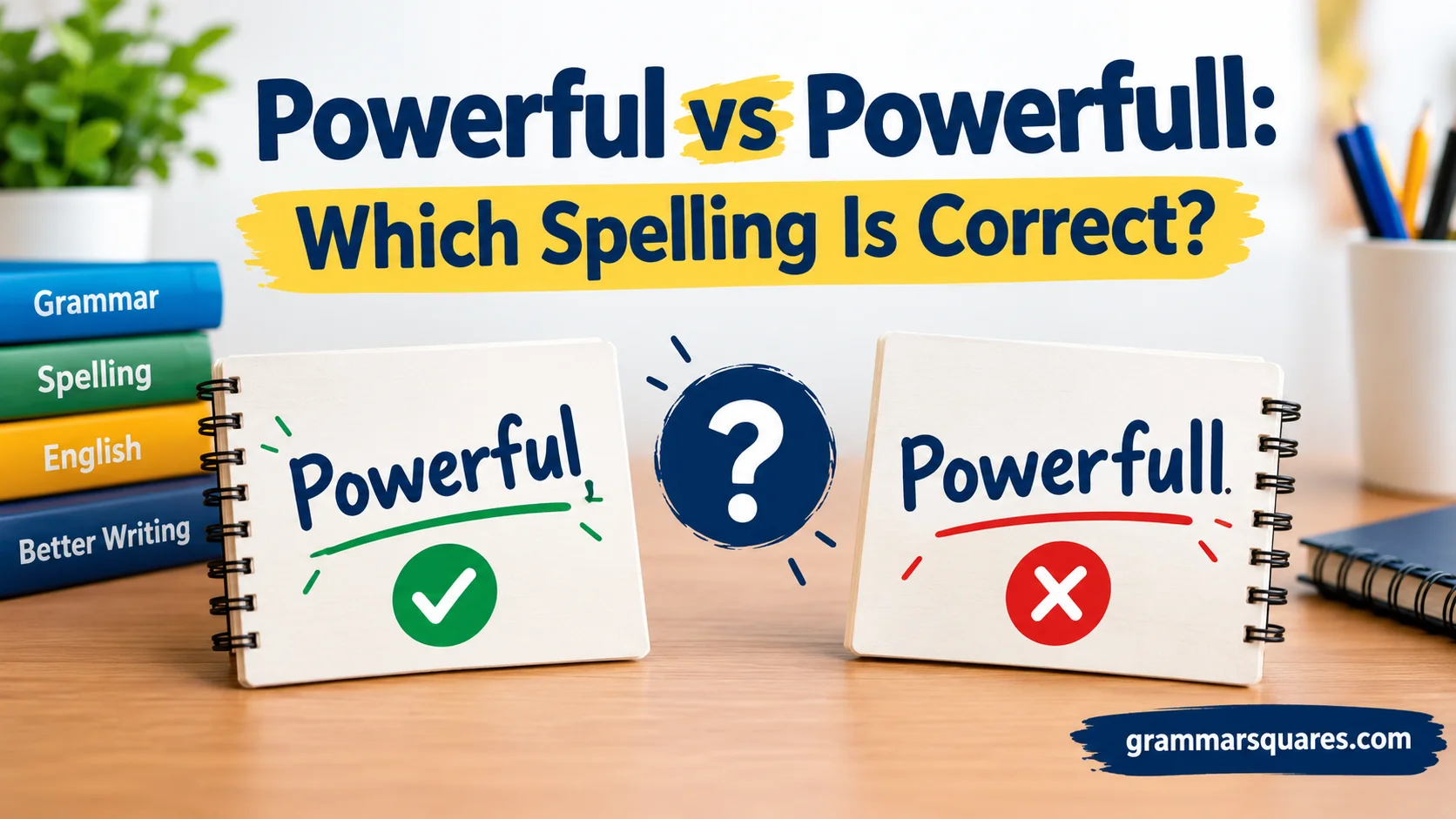

When writing in English, correct spelling matters because even a small mistake can change how your writing looks to readers. The words “Powerful” and “Powerfull” may look almost identical, but only one is standard English spelling. You may see the incorrect version when typing quickly, reading online content, or checking informal messages. Understanding the difference can help you write with confidence and avoid unnecessary spelling errors. Powerful is the correct spelling used in modern English writing. It is an adjective that describes something strong, influential, or effective. For example, you can describe a powerful speech, powerful engine, or powerful emotion. The word is widely used in everyday conversations, academic writing, and professional communication.
The confusion often happens because many English words use double consonants in certain forms. However, “Powerfull” is not the standard spelling and should generally be avoided. The correct form, “Powerful,” uses only one L at the end of the word. This spelling follows the common formation of adjectives ending in “-ful,” meaning full of. For example, helpful, useful, hopeful, and powerful follow a similar pattern. Remembering this simple spelling rule can make English writing easier and more accurate.It also helps you recognize why Powerfull looks incorrect even though it may seem natural.
In this guide, we will explore Powerful vs Powerfull and explain which form is correct. You will learn the meaning, spelling, pronunciation, and common usage of powerful. We will also look at clear examples that show how the word works in sentences. Understanding these examples makes it easier to remember the correct spelling in the future. Whether you are writing an email, essay, article, or social post, accuracy matters. By the end, you will know why Powerful is correct and why Powerfull should be avoided. This simple distinction can help you produce clearer, more professional English every time
Powerful vs Powerfull: The Correct Answer Right Away
Let’s not bury the lead.
WordCorrect?Meaningpowerful✅ CorrectFull of power, strength, or influencepowerfull❌ IncorrectMisspelling, not used in standard English
If you remember one thing from this article, make it this:
“Powerful” always uses one “l” at the end. Never two.
Even if “powerfull” looks right, it doesn’t exist in standard English dictionaries, writing systems, or academic usage.
What Does “Powerful” Actually Mean?
Before we get lost in spelling rules, it helps to understand what the word represents.
Powerful is an adjective that describes something with strength, influence, or impact.
Common meanings include:
- Physically strong (a powerful engine)
- Emotionally impactful (a powerful story)
- Social or political influence (a powerful leader)
- Intensity or force (powerful emotions or winds)
Real-world examples:
- “She gave a powerful speech that moved the audience.”
- “The storm became extremely powerful overnight.”
- “That company is surprisingly powerful in the market.”
The word carries weight. That’s part of why people overthink its spelling.
Why “Powerful” Is the Correct Spelling
Now let’s break it down logically.
The word powerful comes from two parts:
- power (noun)
- -ful (suffix meaning “full of”)
So the structure is:
power + ful = powerful
The suffix “-ful” is extremely important in English. It means “full of” or “characterized by.”
Examples of the same pattern:
- beauty → beautiful
- hope → hopeful
- care → careful
- fear → fearful
- use → useful
Notice something important?
👉 None of them double the “l”.
That’s the rule.
So just like you don’t write “beautifull” or “hopefull,” you don’t write “powerfull.”
The Grammar Rule Behind “-ful” Words
English spelling can feel chaotic, but suffix rules are surprisingly consistent.
Core rule:
The suffix “-ful” always uses a single “l.”
It doesn’t matter what the root word is. The suffix stays unchanged.
Why this rule exists:
The suffix “-ful” historically comes from Old English, where it meant “full of.” Over time, spelling standardized, and the single “l” remained consistent across all words using it.
Key takeaway:
- “-ful” is a suffix
- It does NOT become “-full”
- Even if it sounds like “full,” it is not spelled that way
Why People Think “Powerfull” Looks Correct
Even though it’s wrong, your brain has reasons for wanting that second “l.”
Let’s look at why.
1. The word “full” exists independently
We know words like:
- full
- helpful
- beautiful (which contains “full” in sound)
So your brain tries to “correct” it into something familiar.
2. English often doubles consonants
English does double letters in many words:
- successful
- basketball
- misspell
So it feels logical to apply the same pattern to “powerful.”
But here’s the catch:
That doubling rule doesn’t apply to suffix “-ful.”
3. Pronunciation confusion
When spoken, “powerful” ends with a soft “ful” sound.
It can feel like:
- “power-full”
So writers unconsciously add the second “l” to match what they hear.
4. Overgeneralizing spelling patterns
English learners often do this:
- learn one rule
- apply it everywhere
That leads to mistakes like:
- powerfull ❌
- beautifull ❌
- usefull ❌
Powerful vs Powerfull: Side-by-Side Comparison
Let’s make it visually crystal clear.
FeaturePowerfulPowerfullDictionary usageStandardNot acceptedGrammar ruleCorrect “-ful” suffixIncorrect doublingWord structurepower + fulpower + full (wrong suffix)Usage in writingFormal and correctConsidered a spelling errorAcademic acceptanceYesNo
Real Examples: Correct vs Incorrect Usage
Seeing the word in context helps lock it in.
Correct usage:
- “The athlete delivered a powerful performance.”
- “That documentary was powerful and emotional.”
- “She has a powerful voice in the industry.”
Incorrect usage:
- “The athlete delivered a powerfull performance.” ❌
- “That documentary was powerfull and emotional.” ❌
Even though the second version looks familiar, it immediately signals an error to fluent readers.
Other Words People Confuse with “Powerful”
This mistake doesn’t happen alone. It shows up in a family of similar words.
Common mistakes:
CorrectIncorrectpowerfulpowerfullbeautifulbeautifullhelpfulhelpfullcarefulcarefullusefulusefull
Pattern to remember:
If it ends in “-ful,” it only needs one “l.”
Read More: Commit vs “Comit”: When to Use Each One?
The Adjective and Adverb Forms of “Power”
Understanding word forms helps you use English more confidently.
Adjective:
- powerful → “a powerful machine”
Adverb:
- powerfully → “She spoke powerfully”
Noun form:
- power → “He has a lot of power”
Comparison table:
FormWordExampleNounpowerPower can change outcomes.AdjectivepowerfulThat is a powerful idea.AdverbpowerfullyHe argued powerfully.
Quick Memory Tricks to Remember the Correct Spelling
Let’s make this stick.
Trick 1: The “ONE L rule”
“-ful always keeps one L. No exceptions.”
Trick 2: Think of “full of”
Say it like:
- power + full of impact (meaning-wise)
- but spelling drops one “l”
Trick 3: Pattern recognition
If it ends in:
- hope + ful → hopeful
- power + ful → powerful
Same structure every time.
Why Correct Spelling Matters More Than You Think
You might wonder—does one extra “l” really matter?
Yes. And here’s why.
1. Professional credibility
Spelling mistakes can make writing feel rushed or careless.
2. Academic grading
Teachers often mark spelling errors, even small ones
4. Reader trust
Fluent readers notice small mistakes instantly.
Case Study: How Small Spelling Errors Affect Perception
Imagine two short messages:
Message A:
“That was a powerful presentation. Well done.”
Message B:
“That was a powerfull presentation. Well done.”
Even if the meaning is identical, readers often interpret Message B as less polished.
Why?
- It signals lack of attention to detail
- It interrupts reading flow
- It reduces authority subtly
This shows how spelling shapes perception, not just correctness.
Conclusion
In conclusion, Powerful is the correct spelling in standard English, while Powerfull is incorrect. The word powerful is an adjective used to describe something strong, effective, influential, or forceful. Although “Powerfull” may look reasonable because some English words contain double consonants, it does not follow the spelling pattern used with the suffix “-ful.” Remember that words such as helpful, useful, hopeful, and powerful normally use only one “l” at the end. Using the correct spelling helps make your writing clear, accurate, and professional. Whether you are writing an email, essay, article, or social media post, choose powerful rather than “powerfull.”
Learning this small spelling difference can help you avoid common English mistakes. If you are ever unsure, remember that the correct form is P-O-W-E-R-F-U-L. With regular practice, this spelling becomes easy to recognize and remember. Using powerful correctly will also make your sentences look more polished and natural. Keep this simple rule in mind whenever you write about something strong, impressive, or influential.
FAQs
1. Is Powerful or Powerfull correct?
Powerful is the correct spelling in standard English. Powerfull is a common spelling mistake and should be avoided.
2. Why is Powerful spelled with one L?
The word powerful uses the suffix “-ful,” which is normally spelled with one “l” when added to a word.
3. What does Powerful mean?
Powerful means having great strength, influence, effectiveness, or force. For example, “She gave a powerful speech.”
4. Is Powerfull an English word?
No, Powerfull is not the standard spelling of the English adjective. The correct form is powerful.
5. How can I remember the spelling of Powerful?
Remember power + ful = powerful. Think of “ful” as the suffix, which helps you avoid adding an extra l.




1 thought on “Powerful vs Powerfull: Which Spelling Is Correct? ”