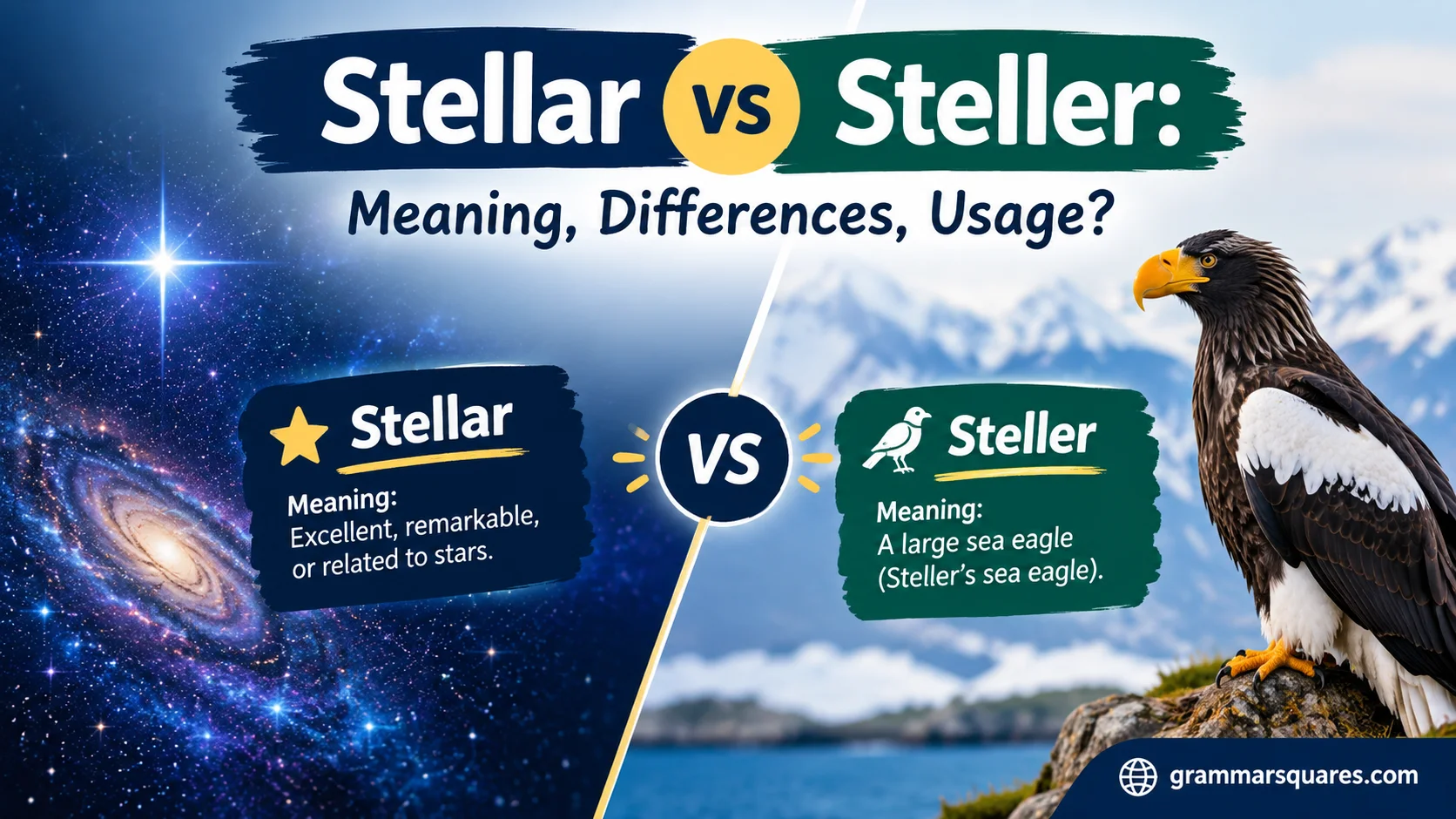

Understanding the difference between Stellar vs Steller can help you avoid a common spelling mistake. The word stellar is widely used to describe something excellent, outstanding, or impressive.It can also relate to stars or outer space, depending on the context. For example, you might call an excellent performance a stellar achievement or discuss stellar objects. On the other hand, steller is much less common and has a different use. Knowing their meanings and usage makes your writing clearer and more accurate.
The main difference between stellar and steller is their meaning and purpose. Stellar is a standard English word that often describes something exceptionally good. It can also function as an adjective in astronomy and science, where it means related to stars. Steller, however, is generally used in proper names, especially in names connected with natural history. For instance, Steller’s sea eagle and Steller’s jay are recognized names for particular species. Because the two words look and sound similar, they can easily cause confusion in writing.
In this guide, you’ll learn stellar vs steller through simple meanings, examples, and usage rules. You’ll see when to use stellar for something excellent or star-related in everyday writing. You’ll also discover why Steller appears mainly in specific names and scientific contexts. Clear examples can make the difference easier to remember and apply correctly. Whether you’re writing an email, article, school assignment, or professional document, accurate spelling matters. By the end, you’ll have a clear understanding of both words and when each one belongs.
Stellar vs Steller: The Core Difference in Simple Terms
Before diving deep, here’s the simplest explanation:
- Stellar = an adjective meaning excellent or related to stars
- Steller = a proper name used in science, history, or species naming
That’s it. The entire confusion comes from spelling similarity, not meaning overlap.
Quick mental shortcut
- If you’re praising something → use stellar
- If you’re naming something (especially a species or person) → it might be Steller
Now let’s explore each word in depth so you actually understand how to use them, not just memorize them.
What Stellar Means in Real English Usage
Stellar as a word of excellence
The word stellar works as an adjective. You use it when you want to describe something outstanding, impressive, or top-tier.
It often appears in everyday English like this:
- Stellar performance
- Stellar job
- Stellar reputation
- Stellar results
It adds emotional weight. Instead of saying “good,” you say “stellar” when something stands out.
Example in real writing
- “She delivered a stellar presentation that impressed the entire board.”
That sentence doesn’t just say she did well. It highlights excellence.
Stellar in science and astronomy
The second meaning comes from astronomy. Here, “stellar” relates to stars.
You’ll see it in scientific contexts like:
- Stellar evolution (how stars change over time)
- Stellar systems (groups of stars)
- Stellar atmosphere (outer layers of a star)
In this sense, the word connects directly to stars and space science.
Example
- “Astronomers study stellar formations to understand how galaxies develop.”
This use feels more technical but still follows the same root idea: stars.
Why stellar feels so powerful in language
Writers love “stellar” because it carries positive energy without sounding exaggerated.
Compare:
- Good performance ❌ (flat)
- Great performance ⚖️ (neutral)
- Stellar performance ✅ (strong and expressive)
It sits in that sweet spot between casual praise and strong admiration.
What Steller Actually Means and Why It Exists
Now let’s talk about the tricky one: steller.
Unlike “stellar,” this word doesn’t function as a standard descriptive adjective in modern English.
Instead, you’ll usually see it in one of these cases:
Steller as a proper noun
The most common source is the German naturalist Georg Wilhelm Steller.
He worked in the 18th century and discovered or documented several species during expeditions in the North Pacific region.
Because of him, several species carry his name:
- Steller’s sea lion
- Steller’s jay
- Steller’s sea cow (now extinct)
So “Steller” in these cases refers to the scientist’s surname.
Steller in biology and species naming
Biology often uses possessive naming conventions to honor discoverers.
That’s why you see:
- Steller’s sea lion
- Steller’s eider
- Steller’s sea eagle (less common references depending on classification usage)
In all these cases:
- “Steller” is not describing quality
- It identifies origin (named after Steller)
Example
- “The Steller’s jay stands out with its dark blue feathers and black crest.”
Notice how “Steller’s” behaves like a label, not an adjective.
Steller as a common misspelling
Outside of biology and history, most uses of “steller” come from mistakes.
People often type:
- “steller performance”
- “steller work”
- “steller team”
In almost all of these cases, they actually mean stellar.
So if you’re not talking about a species or a historical name, you probably don’t need “steller” at all.
Read More: Powerful vs Powerfull: Which Spelling Is Correct?
Stellar vs Steller: Side-by-Side Comparison
Let’s make this crystal clear with a direct comparison.
FeatureStellarStellerPart of speechAdjectiveProper noun / nameMeaningExcellent or related to starsNamed after Georg StellerUsageEveryday English, science, praiseBiology, taxonomy, historyExampleStellar performanceSteller’s sea lionCommon issueRare misuseOften confused with “stellar”
This table shows the key truth:
One describes quality. The other identifies identity.
Why People Confuse Stellar vs Steller So Often
This confusion doesn’t happen randomly. It comes from real language behavior patterns.
1. They look almost identical
One letter separates them:
- stellar
- steller
Your brain often processes them as the same word at a glance.
2. Pronunciation doesn’t clearly separate them
When spoken quickly, both sound nearly identical. That makes spelling harder to recall.
3. Auto-correct doesn’t always help
Some writing tools fail to correct “steller” because it technically exists as a valid proper noun.
So you might type it wrong and still see no red underline.
4. People learn “stellar” later in life
Many people first encounter “stellar” in slang or praise contexts. They don’t always see the spelling clearly reinforced in writing.
5. Search engines blur intent
Search data shows users often type:
- “steller meaning”
- “stellar vs steller difference”
- “is steller a word”
This overlap keeps the confusion alive.
Common Mistakes with Stellar vs Steller
Let’s look at real-world errors people make.
Mistake 1: Using “steller” as praise
❌ “You did a steller job.” ✔️ “You did a stellar job.”
This is the most common mistake. It shows up in resumes, emails, and social media posts.
Mistake 2: Misusing biological names
❌ “Stellar’s sea lion lives in Alaska.” ✔️ “Steller’s sea lion lives in Alaska.”
Here, replacing it changes the meaning completely because it refers to a scientist’s name.
Mistake 3: Confusing spelling in formal writing
Writers sometimes switch between both unintentionally in long documents. That inconsistency hurts credibility.
Memory Tricks to Never Mix Them Up Again
Let’s make this easy to remember.
1. Stellar = Stars + Success
- Think of space
- Think of excellence
- Think of shining performance
2. Steller = Someone’s Name
- Think of Georg Steller
- Think of species labels
- Think of “ownership” in naming
3. Visual trick
- Stellar → has “a” like “amazing”
- Steller → double “l” like a label or name tag
Real-World Examples of Stellar vs Steller
Stellar in everyday writing
- “The team delivered a stellar performance under pressure.”
- “She built a stellar reputation in the industry.”
- “The product received stellar reviews from users.”
Stellar in science
- “Scientists track stellar activity to understand solar systems.”
- “Stellar winds influence the formation of planets.”
Steller in biology
- “The Steller’s sea lion inhabits coastal waters of the North Pacific.”
- “The Steller’s jay is known for its loud calls and intelligence.”
Case Study: How a Simple Spelling Error Changes Meaning
Let’s look at a real-world style scenario.
A marketing agency once published a campaign draft:
“Our team delivered a steller experience for customers.”
At first glance, it looked harmless. But reviewers flagged it immediately.
What went wrong:
- “Steller” suggested a spelling error
- The message lost professionalism
- The brand tone weakened
Fix:
“Our team delivered a stellar experience for customers.”
Result:
- Clear meaning
- Stronger emotional impact
- Professional tone restored
This shows how one missing letter can affect perception in business writing.
Quick Grammar Rules for Stellar vs Steller
Keep this simple checklist in mind:
Use “stellar” when:
- You describe quality
- You praise performance
- You talk about stars or astronomy concepts
Use “Steller” only when:
- You refer to Georg Steller
- You mention species named after him
- You deal with formal biological classification
If you’re unsure, default to stellar.
Here’s a clear conclusion and five short FAQs for “Stellar vs Steller: Meaning, Differences, Usage?”
Conclusion
The difference between stellar and steller is mainly about meaning and usage. Stellar is the common English word used to describe something excellent, outstanding, or related to stars. Steller is much less common and is mainly found in proper names, such as Steller’s jay and Steller’s sea eagle. Remembering this simple distinction can help you avoid spelling mistakes. If you mean something excellent or connected with stars, use stellar. If you are referring to a specific name or species, you may need Steller. Understanding the context makes it easier to choose the correct word.
FAQs
1. What does stellar mean?
Stellar means excellent, outstanding, or exceptionally good. It can also mean something related to stars or astronomy.
2. What does Steller mean?
Steller is mainly used in proper names, especially names associated with certain animals and species, such as Steller’s jay.
3. Is stellar or steller correct?
Both spellings can be correct, but they have different uses. Stellar is the standard English adjective, while Steller usually appears in specific names.
4. Can stellar mean excellent?
Yes. In everyday English, stellar commonly means excellent, impressive, or outstanding. For example, “She gave a stellar performance.”
5. How can I remember stellar vs Steller?
Think of stellar as connected with stars or excellence. Steller is generally associated with proper names, particularly certain species names.




1 thought on “Stellar vs Steller: Meaning, Differences, Usage?”