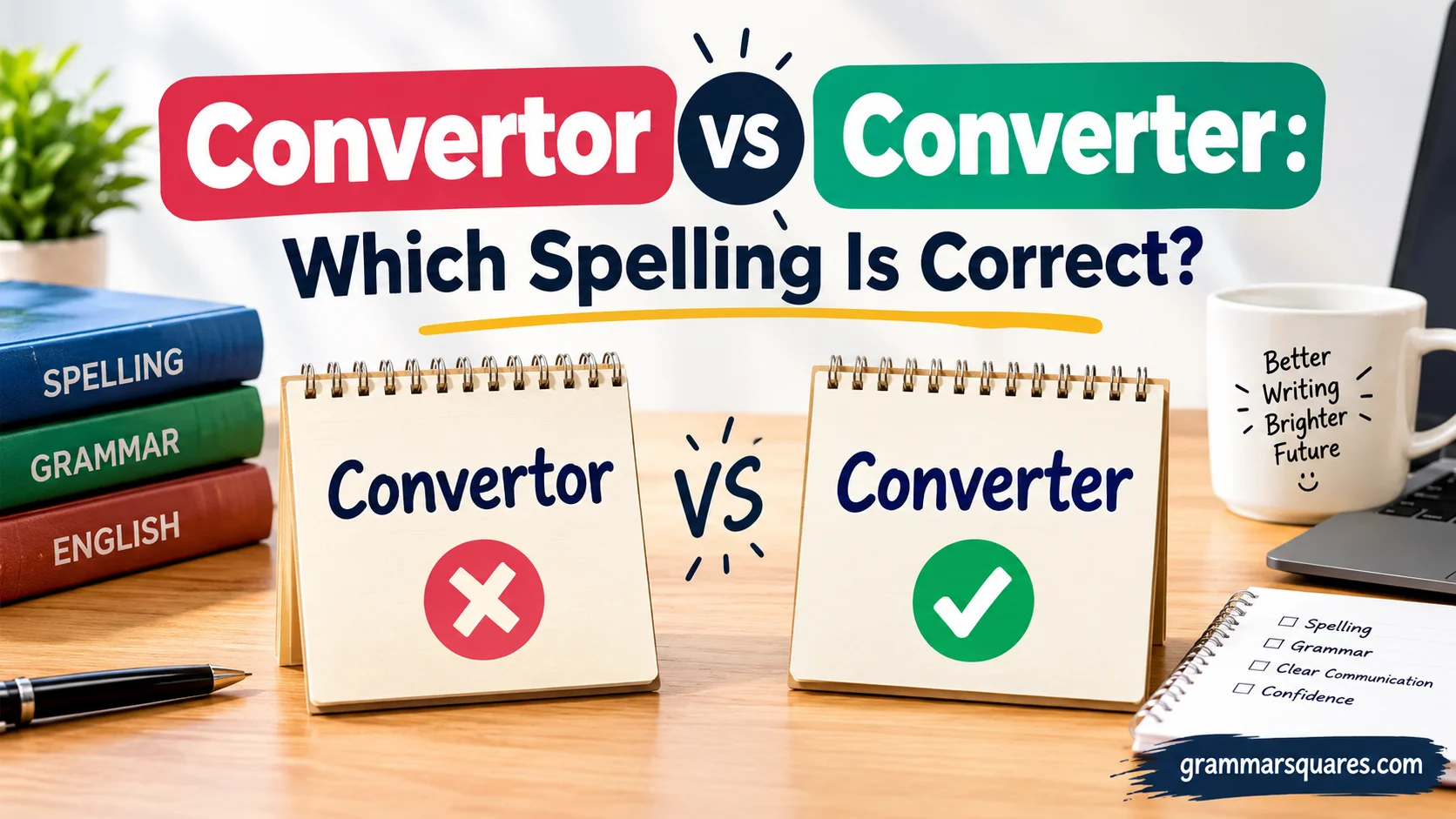

Choosing between Convertor and Converter can be confusing, especially when both spellings appear in different places. The word converter is the standard spelling used in modern English. It commonly refers to a person, device, or software that changes something from one form, type, or system into another. For example, a currency converter changes one currency into another, while a file converter changes a file from one format to a different format. Although convertor can occasionally be found in dictionaries or older texts, it is much less common in everyday and professional English. Understanding this small spelling difference can help you write more clearly and avoid unnecessary mistakes in your emails, articles, and documents. In most situations, choosing converter is the safest and most widely accepted option for modern English writing.
The spelling converter follows a common English pattern in which the ending -er is added to a verb to describe something or someone that performs an action.Since convert means to change, transform, or adapt something, a converter is something that performs this conversion process.You can find the word in many areas, including technology, electronics, mathematics, finance, and everyday communication.Common examples include unit converter, currency converter, PDF converter, and voltage converter, all of which perform a specific type of change.The spelling convertor is not necessarily meaningless, but it is generally considered a rare variant and may look unusual to many readers.Therefore, if you want your writing to sound natural, professional, and familiar, converter is usually the better choice in most contexts.
Knowing the difference between convertor and converter is particularly useful when you are writing for a professional or online audience.Search engines, software interfaces, technical documentation, and most modern publications overwhelmingly use converter as the preferred spelling.For instance, you would normally write “online currency converter” rather than “online currency convertor” when describing a tool that changes monetary values.Similarly, “video converter” and “unit converter” are the natural choices when discussing digital tools and measurement applications.While convertor may occasionally appear as a historical or less common spelling, using it can make your sentence seem unusual or outdated.Throughout this guide, we’ll explore the correct spelling, meaning, usage, examples, and differences between these two forms so you can confidently choose converter in your writing.
Convertor vs Converter: The Short Answer
If you need a quick answer:
Converter is the standard and preferred spelling in modern English.
Convertor is a recognized variant but is much less common and usually appears in specialized technical contexts, legacy engineering documents, or specific product names.
Quick Comparison
| Feature | Converter | Convertor |
| Standard English | Yes | Rare |
| Dictionary Preference | Yes | Limited |
| Academic Writing | Preferred | Usually avoided |
| Business Writing | Preferred | Rare |
| Technology Industry | Preferred | Occasional use |
| Everyday Writing | Preferred | Uncommon |
Simple Rule
Use “converter” unless a specific technical standard, product name, or industry document requires “convertor.”
For most writers, converter is the correct choice.
What Does “Converter” Mean?
A converter is a device, tool, person, or system that changes something from one form, state, format, or function into another.
The word comes from the verb convert, meaning “to change” or “transform.”
Dictionary Definition
A converter is:
Something that converts one thing into another form.
Common Examples of Converters
Technology
- Video converter
- Audio converter
- PDF converter
- File converter
- Image converter
Electronics
- Power converter
- Voltage converter
- Frequency converter
- Signal converter
Automotive
- Catalytic converter
- Torque converter
Finance
- Currency converter
Examples of Converter in Sentences
- I used a file converter to change the document into PDF format.
- The technician installed a new power converter in the system.
- Travelers often use a currency converter before visiting another country.
- Modern vehicles contain a catalytic converter that reduces harmful emissions.
Notice how natural and familiar converter sounds in these examples.
What Does “Convertor” Mean?
The word convertor also refers to something that converts one thing into another.
Technically, the meaning is almost identical.
However, modern English rarely uses this spelling outside specialized industries.
Definition
A convertor is:
A device or mechanism that converts something from one form to another.
While the definition is similar, usage patterns are very different.
Where Convertor Is Still Used
Although uncommon, convertor may appear in:
Engineering Documents
Some industrial systems continue using older terminology.
Manufacturing Industries
Certain technical manuals use convertor due to historical naming conventions.
Legacy Technical Literature
Older publications may retain the spelling convertor.
Product Names
Some manufacturers intentionally choose convertor as part of a product’s official name.
Examples of Convertor in Sentences
- The steel plant installed a new oxygen convertor.
- The engineering manual referenced a rotary convertor system.
- The company retained the original spelling in its product documentation.
These examples are much more specialized than everyday uses of converter.
Why Are There Two Spellings?
One of the biggest questions is why both spellings exist.
The answer lies in the history of English word formation.
The Root Word
Both words come from:
Convert → Converter / Convertor
English often creates nouns by adding suffixes.
Common English Suffixes
| Suffix | Example |
| -er | Teacher |
| -er | Builder |
| -er | Driver |
| -or | Actor |
| -or | Creator |
| -or | Governor |
Historically, English has used both -er and -or endings.
As language evolved, usage patterns became standardized.
For convert, the -er version eventually became dominant.
The Historical Evolution of Converter and Convertor
Language changes over time.
During earlier centuries of English, spelling was often less standardized than it is today.
Early Usage
In older publications, both spellings appeared.
Writers frequently selected spellings based on personal preference, regional influence, or publishing conventions.
Industrial Revolution
As engineering and manufacturing expanded during the nineteenth century, technical terminology became more standardized.
During this period, converter gradually became the preferred form.
Modern English
Today, converter overwhelmingly dominates:
- Dictionaries prefer it.
- Publishers prefer it.
- Universities prefer it.
- Businesses prefer it.
- Software companies prefer it.
Convertor survived mainly in specialized technical fields.
Timeline of Usage
| Period | Dominant Usage |
| Before 1800 | Mixed spellings |
| 1800–1900 | Converter growing |
| 1900–2000 | Converter dominant |
| Today | Converter overwhelmingly preferred |
Convertor vs Converter: The Key Differences
Although both words are technically valid, practical usage reveals important distinctions.
Comparison Table
| Category | Converter | Convertor |
| Modern English | Standard | Rare |
| Frequency | Very High | Low |
| Dictionaries | Preferred | Secondary |
| Academic Use | Common | Rare |
| Business Writing | Common | Rare |
| Software Industry | Standard | Rare |
| Technical Legacy Usage | Sometimes | Commoner |
What Matters Most?
The biggest difference is not meaning.
The biggest difference is acceptance and frequency of use.
Most readers expect to see converter.
Using convertor in ordinary writing may look unusual or even mistaken.
Which Spelling Do Major Dictionaries Prefer?
Dictionary publishers track how words are actually used.
Their recommendations offer a useful guide.
Dictionary Preferences
| Dictionary | Preferred Entry |
| Merriam-Webster | Converter |
| Oxford | Converter |
| Cambridge | Converter |
| Collins | Converter |
| American Heritage | Converter |
Most dictionaries list convertor only as:
- A variant spelling
- A secondary entry
- A specialized usage
This strongly indicates that converter is the accepted standard.
How Common Is Each Word Today?
Usage frequency tells an important story.
Across books, websites, newspapers, journals, and educational materials, converter appears dramatically more often.
Why Converter Dominates
Several factors contribute:
Standardization
Language naturally gravitates toward a dominant form.
Educational Influence
Schools and universities teach converter.
Technology Adoption
Software companies overwhelmingly use converter.
Search Behavior
Most users search for converter rather than convertor.
Real-World Examples
When people search online, they typically look for:
- PDF converter
- Currency converter
- Video converter
- Audio converter
- Power converter
Rarely do they search using convertor.
This reinforces converter as the standard spelling.
Convertor vs Converter in Technology
Technology provides some of the clearest examples of modern usage.
Virtually every major software category uses converter.
File Converters
Examples include:
- PDF converters
- Word converters
- Excel converters
- Image converters
Read More: Jynx vs Jinx: When To Use Each One in Writing
Example
A PDF converter transforms a Word document into a PDF format.
Video Converters
Video converters help users change formats such as:
- MP4
- AVI
- MOV
- WMV
Millions of users rely on video converters every day.
Audio Converters
Audio converters transform files between formats like:
- MP3
- WAV
- FLAC
- AAC
Again, converter is the standard industry term.
Data Converters
Data converters are essential in computing and electronics.
Examples include:
- Analog-to-digital converters
- Digital-to-analog converters
These devices enable communication between digital systems and real-world signals.
Convertor vs Converter in Engineering
Engineering is one area where convertor occasionally survives.
However, converter remains common here as well.
Power Converters
Power converters transform electrical energy.
Examples include:
| Type | Function |
| AC-DC Converter | Converts alternating current to direct current |
| DC-AC Converter | Converts direct current to alternating current |
| DC-DC Converter | Changes voltage levels |
| Frequency Converter | Changes electrical frequency |
Most modern engineering publications use converter.
Historical Industrial Convertors
Certain industries retained the spelling convertor.
Examples include:
- Steel convertors
- Rotary convertors
- Mercury-arc convertors
Many of these terms originated decades ago and remain unchanged due to tradition.
Convertor vs Converter in the Automotive Industry
The automotive industry provides one of the most recognizable examples.
Catalytic Converter
A catalytic converter reduces harmful emissions from vehicle exhaust systems.
It converts pollutants into less harmful substances.
The industry universally uses converter, not convertor.
Torque Converter
Automatic transmissions use torque converters to transfer engine power efficiently.
Again, converter is the accepted spelling.
Is Convertor a Mistake?
Not necessarily.
This is an important distinction.
Convertor Is a Real Word
The spelling exists and has historical legitimacy.
However
In modern general English:
- It is uncommon.
- It may appear outdated.
- It can distract readers.
- It is rarely preferred.
Therefore, many editors replace convertor with converter unless there is a technical reason not to.
British English vs American English
Many spelling differences arise because British and American English evolved differently.
Examples include:
| American | British |
| Color | Colour |
| Organize | Organise |
| Center | Centre |
However, convertor vs converter is not one of these differences.
Which Version Does Each Use?
| English Variety | Preferred Form |
| American English | Converter |
| British English | Converter |
| Canadian English | Converter |
| Australian English | Converter |
This is one reason converter has become the global standard.
Similar Word Pairs That Cause Confusion
English contains many words with competing spellings.
Examples
| Word Pair | Preferred Form Varies? |
| Adviser vs Advisor | Sometimes |
| Adapter vs Adaptor | Context-dependent |
| Inquire vs Enquire | Regional |
| Canceled vs Cancelled | Regional |
| Focused vs Focussed | Style-based |
Convertor vs converter differs because converter overwhelmingly dominates modern usage.
Common Mistakes Writers Make
Understanding these mistakes helps improve writing accuracy.
Assuming Both Are Equally Common
They are not.
Converter is far more common.
Mixing Spellings
Consistency matters.
Avoid writing:
- Converter in one paragraph
- Convertor in another
Choose one form based on your context.
Following Old Technical Documents
Legacy manuals may use convertor.
Modern writing generally should not.
Ignoring Audience Expectations
Readers expect converter.
Unexpected spellings can reduce clarity.
Case Study: Technical Documentation
Imagine two software manuals.
Manual A
Use the file converter to transform images into PDF format.
Manual B
Use the file convertor to transform images into PDF format.
Most readers will perceive Manual A as more natural and professional.
Why?
Because converter aligns with current language conventions.
This demonstrates the importance of audience familiarity.
Examples of Correct Usage
Below are examples from various contexts.
General Writing
- The online converter changed the file instantly.
- I downloaded a currency converter before my trip.
- The converter completed the process in seconds.
Academic Writing
- Researchers utilized a digital-to-analog converter.
- The converter improved signal accuracy during testing.
Business Writing
- Our software includes a built-in PDF converter.
- Customers requested an advanced data converter feature.
Engineering Writing
- The frequency converter increased operational efficiency.
- Engineers upgraded the power converter system.
Automotive Writing
- The catalytic converter reduced harmful emissions.
- A damaged torque converter can affect transmission performance.
Style Guide Recommendations
Professional style guides generally encourage the standard spelling.
For Students
Use converter in essays, reports, and assignments.
For Bloggers
Use converter because readers and search engines recognize it more easily.
For Businesses
Use converter in marketing materials, manuals, and documentation.
For Academic Authors
Use converter unless a specific technical discipline requires otherwise.
For Technical Writers
Follow industry terminology.
If documentation officially uses convertor, retain it.
Otherwise, use converter.
Perspective: Which Spelling Performs Better?
For online content, spelling matters.
Why Converter Is Better Users typically search for:
- PDF converter
- Video converter
- Currency converter
- File converter
These phrases generate significantly more search interest than their convertor counterparts.
Recommendation
If you’re creating content for:
- Blogs
- Websites
- Tutorials
- Product pages
Use converter unless discussing the spelling difference itself.
Quick Reference Cheat Sheet
| Situation | Recommended Spelling |
| School Essay | Converter |
| Blog Article | Converter |
| Business Report | Converter |
| Research Paper | Converter |
| Technical Manual | Usually Converter |
| Legacy Engineering Document | Possibly Convertor |
| Trademarked Product Name | Official Spelling |
Conclusion:
In the debate between Convertor vs Converter, converter is the preferred and standard spelling in modern English. It is widely used for devices, software, tools, and people that change something from one form into another. While convertor can be found as a less common variant, it is not the spelling most readers expect. For professional, academic, technical, and everyday writing, choosing converter is the safest option. Whether you’re writing about a currency converter, unit converter, file converter, or power converter, use converter for clear and natural English.
FAQs
1. Is “converter” the correct spelling?
Yes. Converter is the standard and most commonly used spelling in modern English.
2. Is “convertor” a real word?
Yes, convertor can be found as a less common variant, but converter is much more widely accepted and preferred.
3. What does “converter” mean?
A converter is a person, device, or tool that changes something from one form, type, or system into another.
4. Should I use “convertor” or “converter” in professional writing?
You should generally use converter in professional writing because it is the more common and familiar spelling.
5. What are some examples of “converter”?
Common examples include currency converter, unit converter, file converter, PDF converter, video converter, and power converter.




1 thought on “Convertor vs Converter: Which Spelling Is Correct? ”