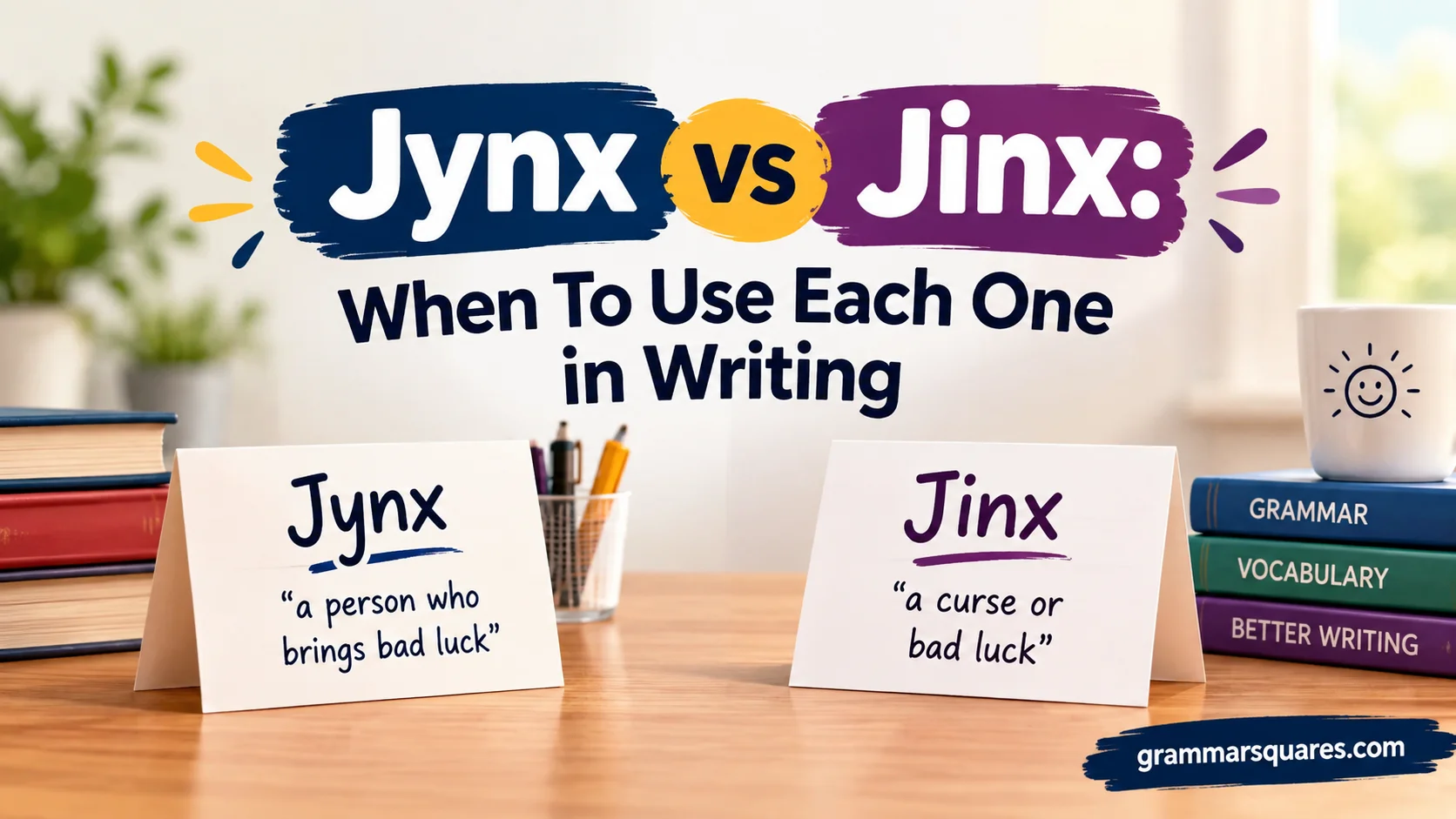

The difference between Jynx and Jinx can be confusing because these words look very similar but aren’t always used in the same way. In standard English, Jinx is the correct spelling when you’re talking about bad luck, misfortune, or someone believed to bring bad luck. The word Jynx is less common and usually appears as a name, username, character, or other proper noun. Knowing the correct spelling and meaning can help you avoid common writing mistakes. This is especially important when you’re writing articles, assignments, emails, or everyday messages. Understanding Jynx vs Jinx makes your writing more accurate, clear, and professional.
The word Jinx is widely used in everyday English conversations and writing and can work as both a noun and verb. As a noun, a jinx means bad luck or a person or thing believed to cause misfortune. As a verb, to jinx something means to bring bad luck to a situation, often by saying something that might tempt fate. For example, people commonly say “Don’t jinx it” when they hope something good will continue. Because Jinx has an established meaning, it is normally the right choice when discussing bad luck. Learning how Jinx works in sentences can make your writing much more natural and confident.
In contrast, Jynx is not normally used as the standard spelling for bad luck or misfortune. You might see Jynx used as a name, a brand, online username, fictional character, or another specific title or identity. Therefore, choosing Jynx instead of Jinx in ordinary English can make your sentence look incorrect or misspelled. The easiest way to remember the difference is to use Jinx for bad luck and reserve Jynx for specific names or contexts. By understanding this simple spelling distinction, you can avoid confusion and unnecessary errors. In this guide, we’ll explore Jynx vs Jinx, their meanings, examples, and when to use each one correctly.
Jynx vs Jinx: What’s the Difference?
The primary difference is simple:
| Word | Meaning | Standard English? |
| Jinx | Bad luck, or to bring bad luck | Yes |
| Jynx | Alternative spelling mainly used as a name or brand | No |
In most writing situations, jinx is the correct choice.
Quick Examples
✅ Correct:
- Don’t jinx the team’s chances of winning.
- I think that old chair is a jinx.
❌ Incorrect in standard writing:
- Don’t jynx the team’s chances.
- That chair is a jynx.
The only time Jynx would be correct is when it is part of a specific name, title, username, or brand.
What Does “Jinx” Mean?
The word jinx has two primary uses in English.
Jinx as a Noun
As a noun, jinx refers to a person, thing, or situation believed to bring bad luck.
Examples
- That broken clock seems like a jinx.
- Some athletes believe certain objects are a jinx.
- The old stadium was considered a jinx for visiting teams.
Common Characteristics of a Jinx
A jinx is often associated with:
- Repeated misfortune
- Superstition
- Negative outcomes
- Bad luck beliefs
- Sports traditions
Jinx as a Verb
As a verb, jinx means to cause bad luck or spoil a favorable outcome.
Examples
- Don’t jinx our vacation plans.
- He jinxed the game by predicting an easy victory.
- I hope I haven’t jinxed the weather by talking about sunshine.
This verb usage is extremely common in everyday English.
The Origin and History of the Word “Jinx”
The word jinx has a fascinating history.
Language experts generally trace the word back to the late nineteenth and early twentieth centuries. It became popular in American English as a term associated with bad luck, curses, and unfortunate events.
Some researchers believe the word may have originated from an older term connected with magic or charms.
Historical Development of Jinx
| Time Period | Development |
| Late 1800s | Early appearances in print |
| Early 1900s | Popularized in American slang |
| Mid-1900s | Commonly used in sports and everyday speech |
| Today | Standard English word recognized worldwide |
Over time, jinx evolved from a superstition-related term into an everyday expression used casually by millions of speakers.
Is “Jynx” a Real Word?
This is one of the most common questions writers ask.
The answer depends on how you define “real word.”
In Standard English
Jynx is not recognized as the standard spelling of jinx.
Major dictionaries list jinx as the accepted form.
Therefore:
- Academic writing → Use jinx
- Business writing → Use jinx
- Journalism → Use jinx
- Professional communication → Use jinx
Where Does “Jynx” Appear?
Although it is not the standard spelling, Jynx does appear in several contexts.
Personal Names
Some individuals intentionally use Jynx as a first name, nickname, or stage name.
Usernames
Many online users choose Jynx because it looks distinctive.
Examples:
- Gamer tags
- Social media handles
- Streaming accounts
Brands
Companies sometimes select alternative spellings to make a brand more memorable.
Fiction
Authors occasionally use Jynx for character names.
In these situations, the spelling is intentional rather than incorrect.
Why Do People Confuse Jynx and Jinx?
Several factors contribute to confusion.
Identical Pronunciation
The biggest reason is pronunciation.
Both words are pronounced:
/dʒɪŋks/
Because they sound exactly the same, many people assume both spellings are correct.
Influence of Creative Spelling
Modern culture encourages unique spellings.
Examples include:
| Standard | Creative Version |
| Magic | Magik |
| Phoenix | Fenyx |
| Jinx | Jynx |
People become accustomed to alternative spellings and may assume they are acceptable in formal writing.
Internet and Social Media
Online platforms have increased the popularity of unique spellings.
People often modify words to:
- Secure usernames
- Create memorable identities
- Build personal brands
- Stand out from competitors
As a result, many users encounter Jynx online before seeing jinx in formal writing.
Read More: Dysregulated vs Disregulated: How Are These Words Connected?
When Should You Use “Jinx”?
In nearly all standard writing situations.
Academic Writing
Always use jinx.
Example:
Researchers examined how belief in a jinx influences decision-making.
Professional Writing
Business documents should use the dictionary spelling.
Example:
The manager joked that discussing success too early might jinx the project.
Journalism
News organizations follow standard spelling conventions.
Example:
Fans worried the commentator had jinxed the team’s winning streak.
Blog Writing
Most blogs should also use jinx unless discussing a person or brand named Jynx.
Creative Writing
Even fiction writers generally use jinx unless a character’s name is specifically Jynx.
When Might “Jynx” Be Appropriate?
Although uncommon, there are valid uses.
Personal Names
If someone’s name is Jynx, preserve the spelling.
Example:
Jynx released a new song this week.
Character Names
Fiction often uses unique spellings.
Example:
The wizard named Jynx possessed unusual powers.
Brand Names
Businesses sometimes choose unconventional spellings.
Example:
Jynx Studios launched a new gaming platform.
Online Usernames
Example:
Follow JynxGaming for live streams.
Exact Quotations
Always preserve original spelling when quoting.
Example:
The profile username was “JynxMaster.”
Jinx as a Noun vs Jinx as a Verb
Many writers understand the meaning but struggle with grammar.
Noun Usage
A noun names a person, place, thing, or concept.
Examples:
- He’s a jinx.
- That trophy became a jinx.
- The old jersey was considered a jinx.
Verb Usage
A verb expresses action.
Examples:
- Don’t jinx us.
- You jinxed the celebration.
- Stop trying to jinx the event.
Comparison Table
| Usage | Example | Function |
| Noun | He’s a jinx. | Person causing bad luck |
| Noun | The object is a jinx. | Thing causing bad luck |
| Verb | Don’t jinx it. | Cause bad luck |
| Verb | She jinxed the game. | Action |
Common Expressions That Use “Jinx”
The word appears in several popular expressions.
Don’t Jinx It
Meaning:
Don’t say something that could cause bad luck.
Example:
We’re winning easily—don’t jinx it.
You Jinxed It
Meaning:
Someone is blamed for causing a negative outcome.
Example:
You said we’d win for sure, and now we’re losing. You jinxed it!
Double Jinx
Meaning:
A childhood phrase used when two people say the same thing simultaneously.
Example:
Double jinx! You owe me a soda.
Breaking a Jinx
Meaning:
Ending a streak of bad luck.
Example:
The team finally broke its playoff jinx.
Jynx vs Jinx in Pop Culture
Popular culture has played a major role in spreading both spellings.
Why Jinx Became Popular
The concept of bad luck appears frequently in:
- Movies
- Television
- Sports commentary
- Literature
- Folklore
Because of this exposure, the word became deeply embedded in everyday language.
Why Jynx Appears in Entertainment
Creative industries often prefer unusual spellings because they are:
- Easier to trademark
- More memorable
- Visually distinctive
- Better for branding
This explains why Jynx occasionally appears as a character or performer name.
Common Mistakes Writers Make
Understanding these mistakes can improve your writing instantly.
Using Jynx in Formal Writing
This is the most common error.
Incorrect:
The coach feared he might jynx the game.
Correct:
The coach feared he might jinx the game.
Assuming Both Spellings Are Interchangeable
They are not.
Jinx is standard English.
Jynx is usually a proper noun or creative spelling.
Copying Social Media Spellings
Social media does not determine grammar rules.
A spelling commonly seen online may still be incorrect in professional writing.
Ignoring Context
Always consider whether you’re discussing:
- A common English word
- A specific person
- A brand
- A fictional character
Context determines the correct spelling.
Jinx vs Jynx vs Jinxed vs Jinxing
Writers frequently confuse related forms.
Jinx
Base word.
Examples:
- That’s a jinx.
- Don’t jinx it.
Jinxed
Past tense or adjective.
Examples:
- We jinxed the game.
- The season felt jinxed.
Jinxing
Present participle.
Examples:
- Stop jinxing our chances.
- She keeps jinxing every prediction.
Jynx
Alternative spelling used primarily as a name.
Examples:
- Jynx posted a new video.
- Jynx performed on stage.
Comparison Table
| Word | Part of Speech | Usage |
| Jinx | Noun/Verb | Standard English |
| Jinxed | Verb/Adjective | Past action |
| Jinxing | Verb | Ongoing action |
| Jynx | Proper Noun | Name or brand |
How Editors and Style Guides Treat the Word
Professional editors prioritize consistency and dictionary standards.
What Editors Recommend
Most editors follow these principles:
Use Jinx
For:
- Books
- Newspapers
- Magazines
- Academic papers
- Corporate communication
Use Jynx
Only when:
- Referring to an official name
- Quoting someone
- Mentioning a brand
- Discussing a fictional character
Why Consistency Matters
Consistent spelling improves:
- Readability
- Credibility
- Search engine optimization
- Professionalism
Readers expect standard spelling in serious content.
Real-World Examples of Correct Usage
Sports Example
A commentator says:
This kicker hasn’t missed all season.
The kicker immediately misses.
Fans respond:
You jinxed him!
This is one of the most common modern uses of the word.
Business Example
A startup announces success before a major contract is finalized.
Employees jokingly say:
Don’t jinx the deal.
Again, the standard spelling is used.
Personal Branding Example
A streamer chooses the name:
JynxPlays
Here, Jynx functions as a proper name rather than a dictionary word.
Style Guide for Writers
Use this simple decision chart.
| Situation | Correct Choice |
| Essay | Jinx |
| Blog Post | Jinx |
| News Article | Jinx |
| Academic Research | Jinx |
| Business Email | Jinx |
| Character Name | Jynx (if intended) |
| Brand Name | Jynx (if official) |
| Username | Jynx (optional) |
Quick Rules to Remember
If you’re unsure which spelling to use, follow these rules.
Use “Jinx” When:
- Writing standard English
- Publishing articles
- Creating academic content
- Writing business documents
- Following style guides
- Communicating professionally
Use “Jynx” When:
- Referring to a person’s name
- Mentioning a brand
- Discussing a fictional character
- Quoting exact spellings
- Referencing usernames
Key Facts About Jinx
| Fact | Detail |
| Standard spelling | Jinx |
| Pronunciation | JINGKS |
| Part of speech | Noun and verb |
| Primary meaning | Bad luck or causing bad luck |
| Formal writing approved | Yes |
| Dictionary recognized | Yes |
| Alternative spelling | Jynx |
| Common use of Jynx | Names and branding |
Conclusion
Understanding the difference between Jynx and Jinx is simple once you know their standard usage. Jinx is the correct and commonly accepted spelling when you mean bad luck, misfortune, or the act of causing bad luck. It can be used as both a noun and a verb, making it useful in many everyday situations. Jynx, meanwhile, is generally used as a name, username, character name, or proper noun rather than the standard word for bad luck. When you’re writing about misfortune or tempting fate, choose Jinx. Keeping this simple distinction in mind will help make your English writing clearer, more accurate, and professional.
FAQs
1. Is “Jynx” or “Jinx” correct?
Jinx is the correct standard spelling when you mean bad luck or misfortune. Jynx is usually used for a specific name or proper noun.
2. What does “Jinx” mean?
Jinx can mean a person, thing, or situation believed to bring bad luck. As a verb, it means to cause bad luck or potentially ruin a positive situation.
3. Is “Jynx” a misspelling of “Jinx”?
Not always. Jynx can be intentional when it is used as a name, username, brand, or character. However, it is generally incorrect if you intend to use the standard word meaning bad luck.
4. How do you use “Jinx” in a sentence?
You can use Jinx as a noun or verb. For example: “That broken mirror is considered a jinx.” As a verb: “I hope I didn’t jinx our chances.”
5. How can I remember Jynx vs Jinx?
A simple trick is to remember “Jinx = bad luck.” Use Jinx when discussing misfortune, curses, or tempting fate, while Jynx is generally reserved for names and specific titles.



1 thought on “Jynx vs Jinx: When To Use Each One in Writing ”