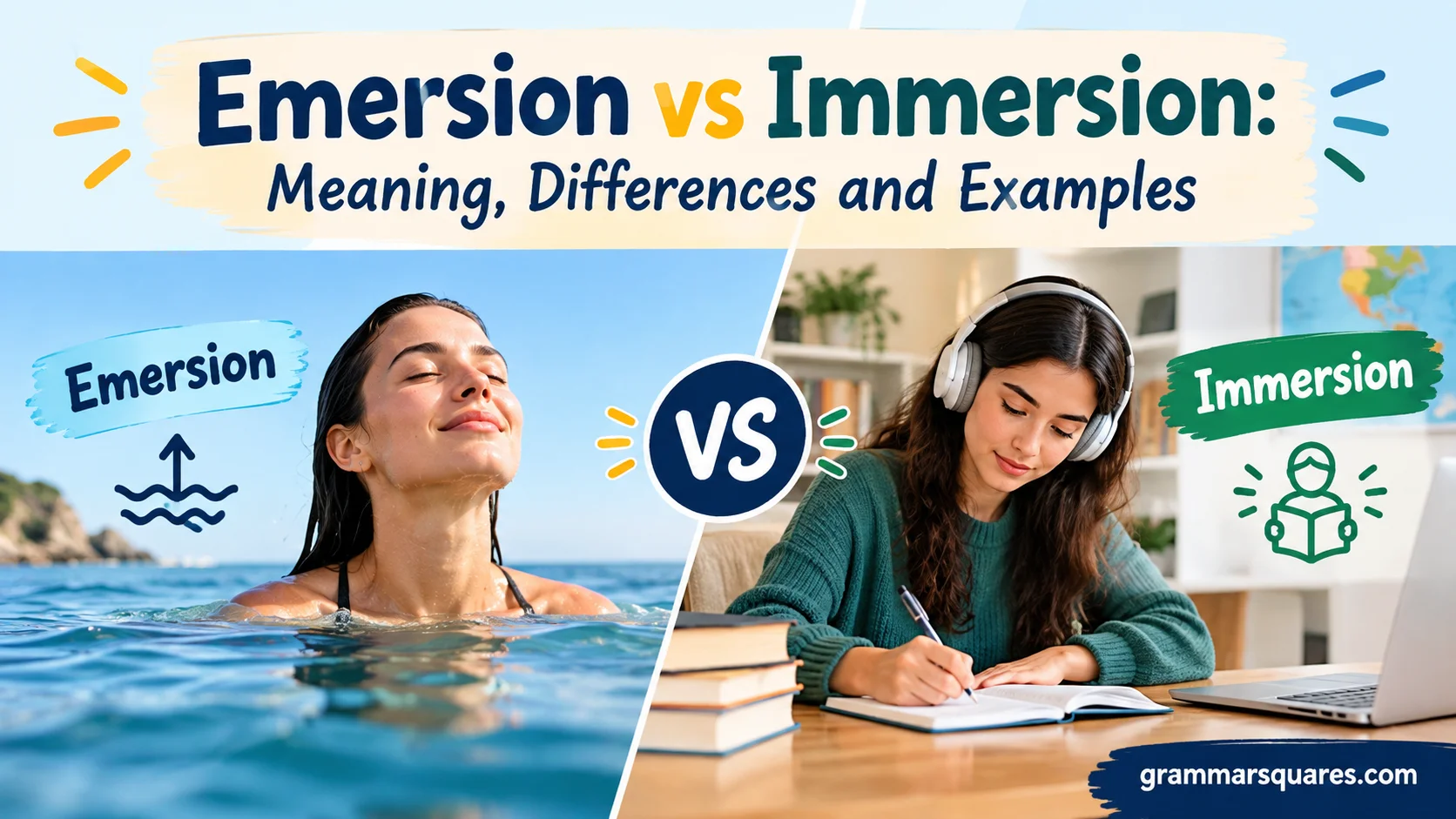

Emersion and immersion may look identical, but their different meanings describe opposite actions, creating confusion for English learners, writers, and students. Emersion meaning is coming out, emerging, or rising toward the surface, while immersion meaning involves being placed into something and becoming completely surrounded by it. The difference between emersion and immersion becomes easier with a scuba diver: leaving the ocean and reaching the air shows emersion, while diving deeply shows immersion. Their related roots and Latin roots explain why they look similar and sound related, even though they point in opposite directions. Simple definitions, real-world examples, and practical memory tricks make the core difference crystal clear.
In English grammar, language learning, biology, marine biology, marine science, psychology, education, virtual reality, school learning, cultural experiences, and other specialized fields, knowing the correct term helps you communicate accurately. Immersion also appears in everyday communication, including language immersion and immersion blenders. When comparing these confused words side by side, their uses become easier to understand.
Writers sometimes mistakenly use them interchangeably, especially when paused mid-sentence and wondering how to write the right sentence in an essay, academic paper, blog post, professional document, or scientific writing. The best tips are to focus on the exact meaning, consider the situations, and remember when to use each word. This complete guide helps you use them correctly, avoid common vocabulary mistakes and common mistakes, understand the key differences, and feel confident when choosing the right word every time.
Emersion vs Immersion: Why These Two Words Get Confused
Let’s start with the core issue.
People confuse emersion vs immersion because:
- The words look almost identical
- They share Latin roots
- Both involve movement relative to a surface
- One of them (emersion) is rarely used in everyday conversation
So your brain naturally defaults to the more familiar word: immersion.
But here’s the catch: they describe opposite actions.
- Immersion = going into something
- Emersion = coming out of something
Think of it like a scene in a movie:
- A character dives underwater (immersion)
- Later, they surface and breathe again (emersion)
Simple, but powerful.
What Does Immersion Mean? (Immersion in Emersion vs Immersion)
Core Meaning of Immersion
Immersion describes being fully surrounded by something or deeply involved in it. It can be physical, mental, emotional, or digital.
At its core:
Immersion means complete involvement or absorption inside a system or environment.
Where the Word Immersion Comes From
The word comes from Latin immersio, meaning “to dip into.”
That origin still shapes how we use it today.
Types of Immersion in Real Life
Immersion shows up in many areas:
1. Language Immersion
- Students learn a language by living inside it
- They hear, speak, read, and think in the target language daily
Example:
- A student moves to Spain and learns Spanish by interacting only in Spanish.
2. Digital or VR Immersion
- Virtual Reality creates a fully interactive environment
- Your senses get “tricked” into feeling present elsewhere
Example:
- VR gaming where you feel like you’re inside the game world
3. Educational Immersion
- Deep learning through hands-on experience
- No passive memorization
Example:
- Medical students practicing real surgeries in simulations
4. Emotional or Mental Immersion
- Getting deeply focused on a book, movie, or task
Example:
- You lose track of time while reading a novel
Key Idea of Immersion
- You go into an experience
- You become fully involved
- External distractions fade away
In simple terms:
Immersion = being inside the experience completely
What Does Emersion Mean? (Emersion in Emersion vs Immersion)
Core Meaning of Emersion
Emersion refers to the act of emerging or coming out of something, especially after being submerged or hidden.
At its core:
Emersion means the process of becoming visible or reappearing after being inside or covered.
Where the Word Emersion Comes From
It comes from Latin emergere, meaning “to rise out.”
That root connects directly to modern words like “emerge.”
Where Emersion Is Used
Unlike immersion, emersion is rare in everyday language, but it still matters in technical fields.
1. Astronomy
- Used when a planet or moon reappears after passing behind another object
Example:
- A star becomes visible again after an eclipse phase
2. Biology
- Organisms emerging from water or hidden environments
Example:
- Aquatic insects leaving water during development stages
3. Scientific Observation
- Any process where something transitions from hidden to visible
Key Idea of Emersion
- You come out of something
- You transition from hidden → visible
- It marks reappearance
In simple terms:
Emersion = surfacing or becoming visible again
Emersion vs Immersion: Key Differences Explained Clearly
Now let’s put emersion vs immersion side by side so the contrast becomes crystal clear.
Comparison Table
FeatureImmersionEmersionDirectionInto somethingOut of somethingCore meaningAbsorption or involvementReappearance or emergenceCommon usageVery commonRareContextsEducation, tech, psychology, mediaAstronomy, biology, scientific observationAction typeEntering a stateExiting a stateEmotional toneDeep engagementReturn to visibility
The Simplest Difference
If you remember nothing else, remember this:
- Immersion = going in
- Emersion = coming out
That’s the entire foundation of emersion vs immersion.
Visual Analogy
Imagine a swimming pool:
- You jump into the pool → Immersion
- You climb out of the pool → Emersion
Same system. Opposite directions.
Why People Mix Up Emersion vs Immersion
This confusion is actually pretty logical.
Let’s break it down.
1. Similar spelling
- Immersion
- Emersion
Only one letter changes, so the brain easily blends them.
2. Familiarity bias
We see “immersion” far more often in:
- Gaming
- Education
- Technology
- Marketing
So our brain assumes it’s the only correct term.
3. Rare usage of “emersion”
Most people never see “emersion” outside academic or scientific contexts.
So when they do, it feels unfamiliar.
4. Context overlap
Both involve movement relative to a boundary:
- Water surface
- Physical enclosure
- Conceptual environment
That overlap makes distinction harder.
Emersion vs Immersion Across Different Fields
Let’s see how emersion vs immersion behaves in real disciplines.
Education
Immersion dominates here:
- Language immersion programs
- Immersive learning environments
- Full-sensory teaching methods
Example:
- Students learning English in an English-only classroom
Emersion is rare:
- Mostly absent in education vocabulary
Technology
Immersion is central:
- VR systems
- AR environments
- Interactive simulations
Example:
- A VR headset creates full sensory immersion
Emersion:
- Not typically used in tech contexts
Science
Here both terms appear more clearly.
Immersion:
- Objects entering fluids
- Submerging materials for testing
Emersion:
- Celestial bodies reappearing after eclipse phases
- Organisms exiting aquatic environments
Psychology
- Immersion = deep focus, flow state
- Emersion = returning from absorption back to awareness
Example:
- You finish a movie and slowly “come back” to reality
Case Studies: Emersion vs Immersion in Real Situations
Let’s ground the concept in real-life scenarios.
Case Study 1: Language Immersion Program in Practice
A student moves to Japan for 6 months.
- They attend classes in Japanese
- They shop, eat, and interact in Japanese
- They stop translating in their head
Result:
This is full immersion.
They don’t just study the language. They live inside it.
Case Study 2: VR Gaming Experience
A player uses a VR headset.
- Visuals surround their entire field of vision
- Sound reacts to movement
- Hands interact with virtual objects
Result:
They experience digital immersion.
The brain temporarily accepts the virtual world as “real enough.”
Case Study 3: Astronomical Emersion Event
An astronomer observes a lunar eclipse.
- The moon moves behind Earth’s shadow
- After some time, it slowly reappears
Result:
This is emersion.
The object transitions from hidden → visible.
Case Study 4: Deep Work Session
A writer sits down to work.
- Phone stays off
- Time disappears
- Focus becomes complete
Result:
Mental immersion
But when they stop writing and look around again, that moment reflects emotional emersion.
Memory Tricks to Remember Emersion vs Immersion
Let’s make this easy to remember forever.
1. The “IN vs OUT” Trick
- Immersion = IN
- Emersion = EXIT (OUT)
2. The Letter Trick
- “Im” looks like “in”
- “E” looks like “emerge”
3. The Water Trick
- Dive into water → immersion
- Rise out of water → emersion
4. The Story Trick
Picture this:
You jump into a pool, swim around, then come back up.
That one story contains both words in order:
- Immersion first
- Emersion second
Common Mistakes in Using Emersion vs Immersion
People often make predictable errors with emersion vs immersion.
Mistake 1: Using “emersion” when they mean “immersion”
Example:
- Incorrect: “I had an emersion experience in gaming.”
- Correct: “I had an immersion experience in gaming.”
Mistake 2: Treating them as interchangeable
They are not interchangeable. Direction matters.
Mistake 3: Overusing “immersion” for everything
Not every experience is immersive. Some are just focused or engaging.
Mistake 4: Ignoring context
Scientific writing uses both terms differently than casual writing.
Quick Reference Summary: Emersion vs Immersion
Let’s simplify everything into one clean summary.
Immersion
- Going into something
- Full involvement
- Common in daily language
- Used in tech, education, media
Emersion
- Coming out of something
- Reappearing or surfacing
- Rare in everyday use
- Used in science and astronomy
Final Takeaway: Emersion vs Immersion in One Line
If you strip everything away:
Immersion pulls you into an experience, while emersion brings you back out of it.
That’s the cleanest way to understand emersion vs immersion without overthinking it.
If you want, I can next turn this into an SEO-optimized article with keywords, meta description, and internal linking structure ready for publishing.
FAQs
What is the main difference between emersion vs immersion?
The core difference in emersion vs immersion comes down to direction. Immersion means going into something, while emersion means coming out of something after being inside or hidden. Think of immersion as diving underwater and emersion as resurfacing afterward.
Is immersion more common than emersion in everyday English?
Yes, immersion appears far more often in daily language. You’ll hear it in education, gaming, technology, and media. Emersion, on the other hand, stays mostly in scientific fields like astronomy and biology, so most people rarely encounter it.
Can emersion and immersion be used interchangeably?
No, they cannot. Even though they look similar, emersion vs immersion describes opposite actions. Swapping them changes the meaning completely. For example, “language immersion” is correct, but “language emersion” would be incorrect.
Where is emersion used in real life?
You’ll mainly see emersion in science-based contexts. Astronomers use it when a celestial body reappears after an eclipse. Biologists may use it to describe organisms leaving water or hidden environments. It always involves something becoming visible again.
How can I easily remember emersion vs immersion?
Use a simple mental shortcut:
- Immersion = IN (going into something)
- Emersion = EXIT (coming out of something)
You can also imagine jumping into a pool (immersion) and climbing back out (emersion). That visual makes the difference stick fast.
Conclusion:
The confusion around emersion vs immersion disappears once you focus on direction. Immersion pulls you inward into an experience, environment, or system. Emersion pushes you outward, marking a return to visibility or awareness.
Immersion dominates modern language because it fits everyday experiences like learning, gaming, and digital interaction. Emersion stays quieter, mostly living in scientific language where precision matters more than popularity.
If you remember one thing, keep it simple:
- You enter immersion
- You exit emersion
That small distinction clears up the entire topic and helps you use both words with confidence.