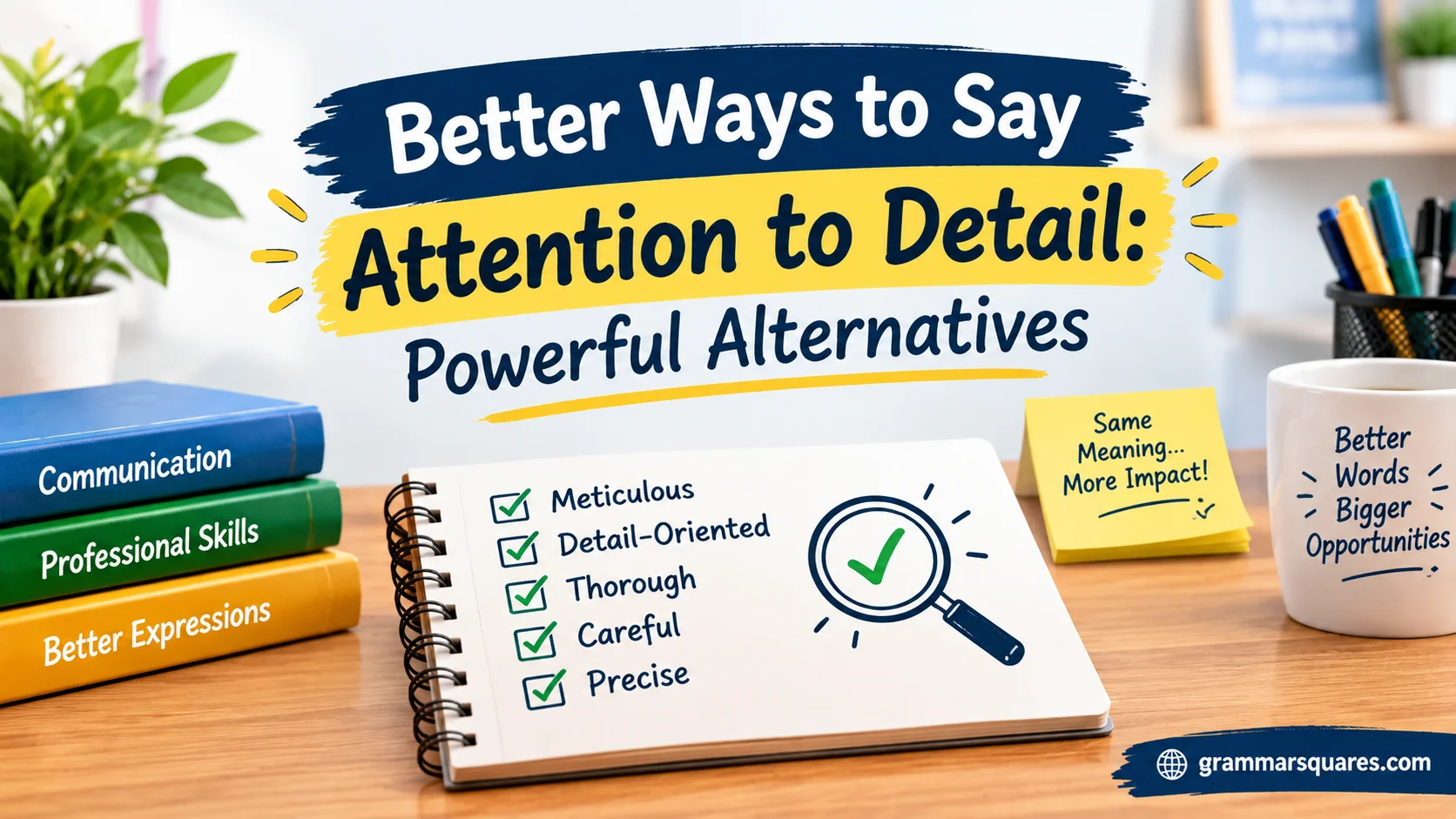

Attention to detail is an important skill that shows how carefully you approach your work, communicate with others, and handle everyday responsibilities. Whether you’re writing a professional resume, preparing for a job interview, or describing your strengths at work, choosing the right words can make a real difference. Instead of repeating the same phrase, you can use powerful alternatives that highlight your ability to notice small things, maintain accuracy, and deliver quality results. These expressions help you sound more confident, professional, and capable while making your writing feel natural. They also allow you to explain your strengths in a way that feels genuine rather than exaggerated. With the right wording, you can show employers and colleagues that you take pride in doing things properly and consistently.
There are many effective ways to express attention to detail, depending on the situation and the message you want to share. For example, phrases such as highly observant, meticulous in my work, and strong eye for detail can communicate your abilities without sounding repetitive. Some alternatives are better suited to formal emails, while others work well in resumes, cover letters, performance reviews, and casual conversations. Choosing the right expression helps you explain your professional strengths more clearly and makes your communication easier to understand. It also allows you to focus on specific qualities, such as accuracy, organization, careful planning, and problem-solving. When you select words that match your experience, you can create a stronger impression while keeping your language simple, clear, and meaningful.
Learning different ways to say attention to detail can help you stand out professionally and communicate your abilities with greater confidence. Rather than simply claiming that you pay attention to small things, you can use specific phrases that demonstrate how you work and what others can expect from you. For instance, describing yourself as detail-oriented, thorough and precise, or committed to accuracy gives readers a clearer picture of your approach. These alternatives are especially useful when you want to improve your resume, prepare for interviews, or write professional messages that reflect your strengths. However, it’s important to choose expressions that genuinely match your skills and experience. In this guide, you’ll discover powerful alternatives, their meanings, practical examples, and the situations where each phrase works best, helping you express your attention to detail in a more natural and memorable way.
Why “Attention to Detail” No Longer Works as a Phrase
Let’s be honest. The phrase sounds good, but it doesn’t say much.
When someone writes “I have strong attention to detail,” they’re basically making a claim without evidence. It’s like saying “I’m a hard worker” without showing any work.
Hiring managers think in one simple way:
Show me, don’t tell me.
The phrase fails because:
- It doesn’t describe a specific action
- It doesn’t prove impact
- It doesn’t differentiate you from other candidates
- It gets repeated so often it loses weight
The reality in hiring decisions
Recruiters typically scan a resume in 6–10 seconds before deciding whether to keep reading. In that short window, vague phrases get ignored.
Compare these two:
- ❌ “Strong attention to detail”
- ✅ “Identified and corrected inconsistencies in 200+ client records before submission”
The second one tells a story. The first one just takes up space.
What “Attention to Detail” Actually Means in Real Work
Before you replace the phrase, you need to understand what it really represents.
Most people think it’s one skill. It’s actually a bundle of smaller abilities.
It usually includes:
- Spotting errors others miss
- Checking work carefully before submission
- Maintaining consistency across tasks
- Following instructions precisely
- Recognizing patterns or irregularities
- Ensuring accuracy under time pressure
Think of it like a magnifying glass. You’re not just “careful.” You’re actively scanning for problems before they grow.
A simple analogy
Attention to detail is like editing a photo before posting it online.
Some people upload it as-is. Others adjust lighting, remove blemishes, and crop carefully. The second group doesn’t just “have attention to detail”—they actively refine the final result.
When You Should Stop Saying “Attention to Detail”
There are moments where using the phrase actually weakens your message.
Avoid it when:
- Writing a resume (it blends in too much)
- Answering interview questions (sounds rehearsed)
- Writing LinkedIn summaries (too generic)
- Doing performance reviews (lacks evidence)
Use this rule instead:
If you can’t attach a real action or result, don’t say it.
Here’s what that looks like in practice:
- Weak: “I have strong attention to detail in data entry.”
- Strong: “I reviewed 1,000+ data entries weekly and maintained near-zero error rates.”
One is a claim. The other is proof.
Better Ways to Say Attention to Detail (By Context)
Now let’s get into what actually works.
Different situations require different phrasing. A resume doesn’t sound like an interview. A performance review doesn’t sound like LinkedIn.
Resume-Friendly Alternatives for Attention to Detail
Resumes need action-focused language. You want verbs, outcomes, and clarity.
Strong alternatives:
- “Reviewed and corrected inconsistencies in reports before submission”
- “Ensured accuracy across financial records and documentation”
- “Identified errors in datasets and implemented corrections”
- “Maintained consistency across client-facing deliverables”
- “Performed quality checks to eliminate reporting errors”
Read More: Challenge or Challange? The Correct Spelling Explained?
Before and after transformation
| Weak Resume Line | Strong Resume Line |
| Attention to detail | Reviewed 300+ documents and corrected formatting inconsistencies |
| Detail-oriented | Verified financial data accuracy across monthly reports |
| Careful worker | Reduced documentation errors by implementing a review checklist |
Notice how the strong versions show action + scope + result.
Interview Answers That Sound Natural (Not Rehearsed)
In interviews, you want to sound human, not scripted. This is where storytelling matters.
Better phrases you can use:
- “I naturally slow down at the end of tasks to catch small errors.”
- “I tend to notice inconsistencies quickly when reviewing work.”
- “I’ve built a habit of double-checking before final submission.”
- “I focus on accuracy because small mistakes can create bigger problems later.”
Example interview response
Instead of saying:
“I have strong attention to detail.”
Say this:
“In my last role, I was responsible for reviewing client invoices. I noticed a repeated rounding error that others missed. I corrected it across multiple records, which prevented billing inconsistencies.”
That answer works because it:
- Shows context
- Shows action
- Shows impact
Performance Review Language That Sounds Professional
Performance reviews need balance. You want to sound confident without exaggeration.
Strong alternatives:
- “Consistently delivers accurate and reliable work”
- “Maintains high standards for quality control”
- “Ensures consistency across recurring tasks”
- “Proactively identifies and corrects errors before escalation”
- “Demonstrates strong accuracy in documentation and reporting”
Pro tip
Managers respond better to behavior-based language than personality traits.
Instead of:
- “Detail-oriented employee”
Use:
- “Consistently identifies inconsistencies in reporting and resolves them before deadlines”
Skills Section Alternatives for LinkedIn or CVs
Your skills section should act like SEO keywords.
Better options than “attention to detail”:
- Quality control
- Accuracy verification
- Data validation
- Process consistency
- Error detection and correction
- Document review and auditing
Think of this section like search optimization. Recruiters look for specific terms, not vague traits.
Strong Action Phrases That Replace “Attention to Detail”
If you only remember one section, make it this one.
These phrases instantly upgrade your writing:
Use these instead:
- “Verified accuracy in…”
- “Cross-checked data for inconsistencies…”
- “Detected and corrected errors in…”
- “Reviewed documentation before submission…”
- “Standardized processes for consistency…”
- “Audited reports for accuracy…”
Why these work
They focus on:
- Action (what you did)
- Object (what you worked on)
- Outcome (what changed)
That structure builds credibility instantly.
Real-World Examples That Show the Difference
Let’s look at how this plays out in real scenarios.
Example 1: Data Entry Role
❌ Weak:
I have strong attention to detail in data entry tasks.
✅ Strong:
I processed over 500 entries per week and maintained a 99.8% accuracy rate through systematic double-checking.
Example 2: Finance Role
❌ Weak:
Detail-oriented accountant with strong analytical skills.
✅ Strong:
I identified discrepancies in monthly financial reports and corrected errors that improved reporting accuracy by 15%.
Example 3: Administrative Role
❌ Weak:
Strong attention to detail in office work.
✅ Strong:
I implemented a document review checklist that reduced filing errors across the department.
Mini Case Study: How Small Language Changes Improve Perception
Let’s look at a realistic hiring scenario.
Candidate A (generic language)
- “Detail-oriented professional”
- “Strong attention to detail”
- “Hardworking and reliable”
Result: The resume gets skimmed and forgotten.
Candidate B (specific language)
- “Reviewed 1,200+ records monthly and corrected inconsistencies before client delivery”
- “Created a validation checklist that reduced reporting errors by 22%”
- “Identified formatting issues in automated reports and improved clarity for stakeholders”
Result: The resume stands out immediately.
What changed?
Not the skill. The language.
Candidate B doesn’t claim attention to detail. They prove it through outcomes.
Common Mistakes People Make
Even when people try to improve their wording, they often fall into traps.
Avoid these:
- Replacing buzzwords with other buzzwords
- Writing vague action phrases without results
- Overusing the same verb (“managed,” “handled,” “worked on”)
- Ignoring numbers or scale
- Forgetting context (what was improved?)
Example of a weak “improvement”
❌ “Checked documents carefully for accuracy.”
Still vague. No impact.
Stronger version
✅ “Reviewed 150+ documents weekly and corrected formatting inconsistencies before submission.”
Simple Framework to Replace “Attention to Detail”
Use this quick method when rewriting your resume or answers.
Ask yourself:
- Did I find an error?
- Use: “identified and corrected…”
- Did I prevent a mistake?
- Use: “prevented inaccuracies in…”
- Did I improve consistency?
- Use: “standardized…”
- Did I verify something?
- Use: “validated” or “cross-checked…”
Example transformation
- “Attention to detail in reports”
→ “Validated monthly reports for accuracy before executive review”
This small shift changes perception completely.
Quick Reference Cheat Sheet
Here’s a simple table you can save or reuse:
| Instead of Saying “Attention to Detail” | Say This Instead |
| I have attention to detail | I verify accuracy before submission |
| Detail-oriented | I detect and correct inconsistencies |
| Strong eye for detail | I review work for errors before delivery |
| Careful worker | I ensure consistent, error-free output |
| Good with details | I cross-check data for accuracy |
Conclusion:
Attention to detail is an important quality that helps you demonstrate accuracy, care, and professionalism in your work. Using different ways to express this skill can make your resume, cover letter, emails, and interviews more effective. Phrases such as detail-oriented, meticulous, highly observant, and committed to accuracy allow you to describe your strengths clearly without repeating the same words. Choosing the right alternative also helps you communicate your abilities in a natural and confident way.
The best phrase depends on your experience, situation, and communication style. Whether you’re applying for a job, describing your professional skills, or communicating with colleagues, use words that genuinely reflect how you work. By choosing meaningful alternatives and supporting them with real examples, you can make a stronger professional impression and show others that you value quality and precision.
FAQs
1. What is another way to say attention to detail?
Some common alternatives include detail-oriented, meticulous, highly observant, thorough, and careful with accuracy. These expressions help you describe your ability to notice small details and complete tasks correctly.
2. How do you professionally say attention to detail on a resume?
You can use phrases such as strong eye for detail, exceptional accuracy, meticulous in my work, or committed to quality. Choose a phrase that reflects your actual skills and supports it with a relevant work example.
3. What is a better word for detail-oriented?
Meticulous is a useful alternative to detail-oriented. Other options include precise, thorough, conscientious, and observant, depending on the quality you want to emphasize.
4. How do you describe attention to detail in an interview?
You can describe yourself as careful, organized, and committed to accuracy. Explain how you check your work, identify mistakes, or manage important details to demonstrate this skill with a real example.
5. Why is attention to detail important in the workplace?
Attention to detail helps reduce errors, improve work quality, support better decision-making, and ensure tasks are completed correctly. It also builds trust with colleagues, managers, and clients by showing that you take your responsibilities seriously.



1 thought on “Better Ways to Say Attention to Detail: Powerful Alternatives ”