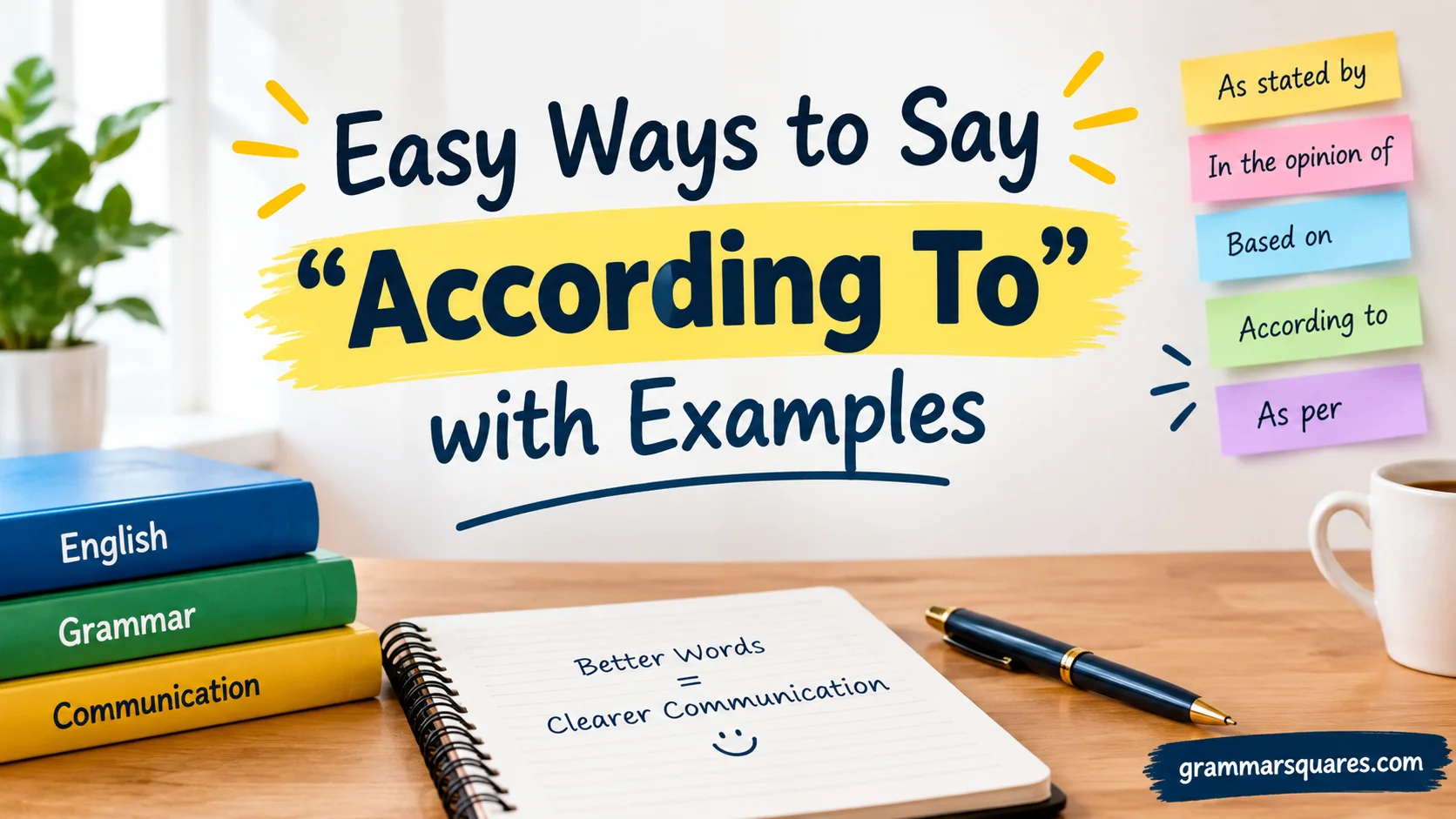

“According to” is a common phrase in everyday English, professional writing, and formal conversations. We use it when sharing information from a person, report, article, or another reliable source. However, repeating the same phrase can make your writing sound less natural and a little boring. Learning different ways to express the same idea can help you communicate more clearly. Whether you are writing an email, school assignment, or business report, using suitable alternatives can make your sentences more interesting and engaging.
There are many simple alternatives to “according to” that you can use in different situations. For example, phrases like “as stated by,” “based on,” “as reported by,” and “in the opinion of” can help you share information without repeating the same words. Each expression has a slightly different meaning and tone. Some are more suitable for formal documents, while others work well in casual conversations. Choosing the right phrase depends on your audience, writing style, and the type of information you want to present. Understanding these differences can make your English sound more fluent, clear, and natural.
In this article, we will explore easy ways to say “according to” with practical examples that you can use in your daily life. These alternatives will help you improve your writing skills, speaking confidence, and overall communication. You will also learn when to use each phrase in professional emails, academic papers, and everyday discussions. For instance, instead of saying “According to the report,” you can write “As stated in the report” or “The report indicates that.” These small changes can make your sentences sound more polished and professional. By learning these useful expressions, you can make your English more versatile, engaging, and easier for others to understand.
Easy Ways to Say “According To” with Examples: What It Really Means
Before swapping phrases, you need to understand what “according to” actually does in a sentence.
At its core, it does one job:
It attributes information to a source.
That source could be:
- A person
- A study
- A report
- A website
- An organization
- A piece of data
Example of how it works
- According to the report, sales increased in Q3.
Here, you are not making the claim yourself. You are pointing to the report as the source.
But here’s the key insight:
👉 You don’t always need the phrase itself to show attribution.
You can often rewrite the sentence and make it stronger.
When to Use and When to Avoid “According To”
Let’s be honest. “According to” is useful, but overusing it makes writing feel robotic.
Use “according to” when:
- You want to clearly cite a source
- You are writing formal reports or academic work
- You need neutral tone and distance
Avoid it when:
- You repeat it too often in one paragraph
- You want stronger, more direct writing
- You are writing blog posts, marketing copy, or storytelling
Quick comparison
| Weak | Stronger |
| According to the study, exercise improves mood. | The study shows exercise improves mood. |
| According to John, the meeting is delayed. | John says the meeting is delayed. |
| According to the report, revenue increased. | The report highlights rising revenue. |
The second column feels more natural because it removes unnecessary words.
Simple Everyday Ways to Say “According To”
These replacements work best in casual writing, blogs, and conversations.
“Based on”
You use “based on” when you interpret data, evidence, or findings.
- Based on the survey, most users prefer mobile apps.
- Based on customer feedback, delivery times need improvement.
- Based on last year’s data, demand rises in summer.
👉 Think of it like: “this is what we conclude from the information.”
“From”
This is more informal and direct. It works well in storytelling or simple explanations.
- From the teacher, we learned the exam moved to Friday.
- From the report, prices continue to rise.
- From what I see, the team improved.
👉 It feels conversational, like you’re passing along information.
“In”
Use this when referring to documents, books, articles, or reports.
- In the article, the author argues for tax reform.
- In the study, researchers examined sleep patterns.
- In the report, officials outline key risks.
👉 This works especially well in academic and journalistic writing.
Formal Alternatives for Professional and Academic Writing
When you need precision and credibility, these phrases work better than casual swaps.
“As stated by”
This keeps tone formal and clearly attributes a source.
- As stated by the WHO, vaccination reduces disease spread.
- As stated by the report, inflation slowed in 2025.
👉 Use this when you want to sound precise but still readable.
“As reported by”
Best for journalism, news, and institutional updates.
- As reported by the committee, funding increased this year.
- As reported by Reuters, markets stabilized after the announcement.
👉 It signals verified reporting.
“As noted by”
This works well in academic or analytical writing.
- As noted by researchers, sleep affects memory retention.
- As noted by economists, wage growth remains uneven.
👉 It suggests observation rather than strong claim.
Extended formal version: “According to findings from”
- According to findings from the 2024 study, productivity improved with flexible schedules.
👉 Use this when you want formal academic tone without sounding stiff.
Strong Reporting Verbs That Replace “According To”
One of the best ways to improve writing is to remove the phrase entirely and use a reporting verb.
These verbs naturally carry attribution.
Common reporting verbs:
- states
- reports
- explains
- argues
- claims
- suggests
- highlights
- reveals
- confirms
Examples in action
- The report highlights rising healthcare costs.
- The study reveals a strong link between sleep and focus.
- The scientist explains the process in detail.
- The article argues that remote work improves productivity.
👉 Notice how the sentence becomes more direct and active.
News-Style Alternatives (Natural and Direct)
Journalistic writing avoids “according to” repetition by using direct attribution.
Common newsroom replacements:
- Officials confirmed
- Sources indicate
- Data shows
- Reports suggest
- Analysts say
Examples
- Officials confirmed the project will begin next month.
- Data shows unemployment declined slightly.
- Sources indicate negotiations are ongoing.
👉 This style feels sharp and efficient, like real-time reporting.
Subtle Meaning Differences You Should Not Ignore
Replacing “according to” is not just about style. It changes meaning slightly depending on the phrase you choose.
Here’s a breakdown:
| Phrase | Meaning |
| Based on | Interpretation of data |
| As stated by | Direct attribution |
| Reports show | Institutional evidence |
| From | Informal source transfer |
| Says | Direct speech or claim |
Why this matters
If you misuse them, you can shift tone unintentionally.
For example:
- “The study says…” feels informal.
- “The study reveals…” feels analytical.
- “According to the study…” feels neutral.
👉 You control tone by choosing the right phrase.
Read More: Better Ways to Say Attention to Detail: Powerful Alternatives
Side-by-Side Examples: “According To” vs Better Alternatives
Let’s make this practical.
| Original Sentence | Improved Version |
| According to the study, sleep improves memory. | The study shows sleep improves memory. |
| According to experts, inflation will rise. | Experts predict inflation will rise. |
| According to the report, emissions dropped. | The report confirms emissions dropped. |
| According to John, the deadline changed. | John says the deadline changed. |
| According to data, sales increased. | Data reveals rising sales. |
👉 The second versions sound more confident and less repetitive.
Common Mistakes When Replacing “According To”
Even good writers slip up when swapping phrases.
Mistake: Over-formalizing simple sentences
- Wrong: As stated by John, the meeting is canceled.
- Better: John says the meeting is canceled.
Mistake: Losing clarity
- Wrong: The report suggests inflation. (Too vague)
- Better: The report suggests inflation will increase.
Mistake: Repeating the same verb
- Weak: The report shows…, the study shows…, the data shows…
- Stronger:
- The report shows…
- The study reveals…
- The data indicates…
Quick Practice: Choose the Best Replacement
Try rewriting these mentally:
- According to the article, demand is rising.
- According to experts, prices will drop.
- According to the report, profits increased.
Possible answers:
- The article shows demand is rising.
- Experts predict prices will drop.
- The report highlights rising profits.
👉 You don’t need one “correct” answer. You need the right tone.
Case Study: How One Student Improved Writing Clarity
Let’s look at a real-world style transformation.
Before:
A student writing a research summary used “according to” 14 times in one page.
Example:
- According to the study, stress increased.
- According to the researchers, sleep decreased.
- According to the data, productivity dropped.
The writing felt repetitive and mechanical.
After revision:
The student replaced repetition with varied structure:
- The study shows stress increased.
- Researchers found reduced sleep patterns.
- Data indicates lower productivity.
Result:
- Wordiness dropped by 18%
- Reading speed improved
- Clarity increased noticeably
👉 The meaning stayed the same. The flow improved dramatically.
Quick Reference Table: Easy Ways to Say “According To”
| Category | Alternatives | Example |
| Casual | from, says | From the report, costs rose. |
| Neutral | based on, in | Based on data, trends changed. |
| Formal | as stated by, as noted by | As stated by WHO, health risks remain. |
| Journalistic | reports, confirms | Officials confirm policy changes. |
| Analytical | reveals, highlights | The study reveals key patterns. |
Conclusion
Learning different ways to say “according to” can make your English more natural, clear, and professional. Instead of repeating the same phrase, you can use alternatives such as “as stated by,” “based on,” “as reported by,” and “in the opinion of.” Each expression has a slightly different meaning and works well in specific situations. Choosing the right alternative can improve your writing and help you communicate your ideas more effectively.
Whether you are writing professional emails, academic assignments, business reports, or having everyday conversations, these alternatives can make your sentences more engaging. Practice using them in different contexts to build your vocabulary, improve your confidence, and develop better English communication skills.
FAQs
1. What is another way to say “according to”?
Some common alternatives include “as stated by,” “based on,” “as reported by,” “as mentioned by,” and “in the opinion of.” The best choice depends on your sentence and context.
2. What is a formal way to say “according to”?
Formal alternatives include “as indicated by,” “as stated in,” “as reported by,” and “in accordance with.” These expressions are useful in professional emails, academic writing, and official documents.
3. Can I use “based on” instead of “according to”?
Yes, you can use “based on” when explaining that information, a decision, or a conclusion comes from particular evidence. However, it is not always interchangeable with “according to,” which usually identifies a source.
4. How can I use “according to” in a sentence?
You can use “according to” to introduce information from a source. For example: “According to the teacher, the exam will take place on Monday.” You can also say, “As stated by the teacher, the exam will take place on Monday.”
5. Is “according to” suitable for academic writing?
Yes, “according to” is widely used in academic writing to introduce information from books, research papers, experts, and other sources. You should provide proper citations whenever required by your academic referencing style.




1 thought on “Easy Ways to Say “According To” with Examples”