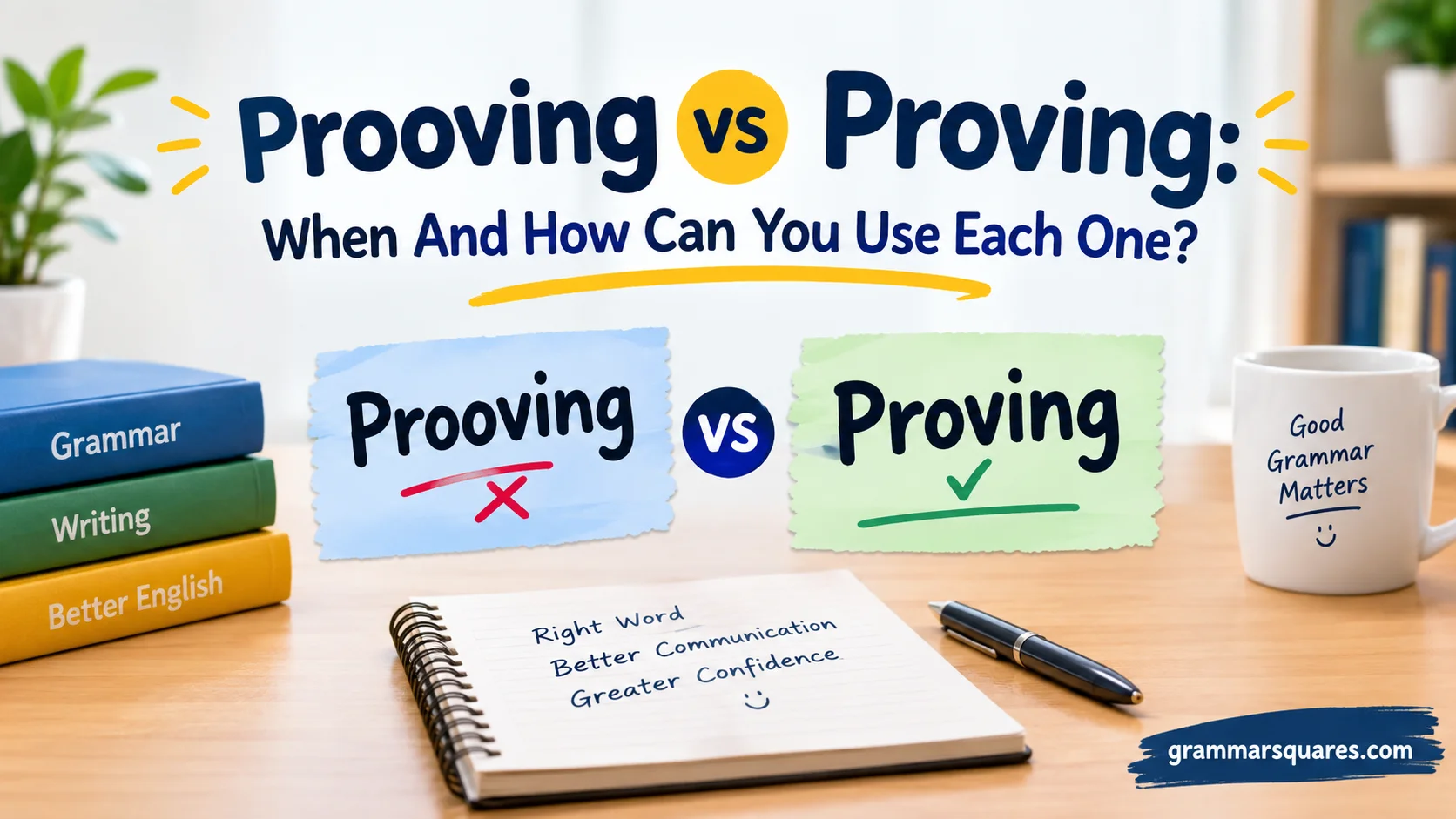

When you are writing in English, correct spelling matters because even a small mistake can change the meaning or make your writing look less polished. Proving is the standard and correct spelling of the verb prove, meaning to show that something is true or valid. Many writers, however, accidentally write prooving because they expect the word to follow a simple spelling pattern. Understanding this difference can help you avoid common spelling mistakes in emails, essays, articles, and everyday writing.
The confusion between prooving and proving usually comes from the way English words change when endings are added. The base verb is prove, and when -ing is added, the final e is removed, giving us proving. The spelling prooving is not considered standard English, even though it may look logical at first glance. Learning this simple spelling rule makes it easier to recognize the correct form and use it confidently. It also helps you write more clearly when explaining, demonstrating, or proving something.
In this guide, we will explore prooving vs proving and explain when and how you can use each form. You will learn why proving is correct, why prooving is generally treated as a spelling error, and how the word works in different sentences. We will also look at clear examples to make the difference easy to remember. By the end, you should feel more confident using proving in your academic, professional, and everyday English writing.
The Core Answer: Prooving vs Proving Explained Simply
Let’s keep this straightforward.
The verb we start with is:
- prove → meaning “to show something is true or valid using evidence”
When we add -ing, we get:
- proving → correct form
There is no stage in English where “prove” becomes “proove.” That double “o” simply does not exist in standard spelling rules.
So the transformation looks like this:
Base VerbCorrect -ing FormIncorrect Formproveprovingprooving ❌
The mistake often happens because people assume English doubles letters randomly. But English spelling follows patterns, not guesses.
Once you understand the pattern behind verbs like “prove,” you stop relying on memory and start recognizing structure.
Why “Prooving” Is Wrong in English
Now let’s break down the real reason “prooving” doesn’t work.
English spelling avoids unnecessary double vowels unless a specific rule demands it. In the case of “prove,” the final -e gets dropped when adding -ing, and nothing else changes.
Here’s the rule in action:
- prove → drop the “e”
- add “ing”
- result → proving
That’s it. No doubling. No extra “o.”
Why your brain might think “prooving” feels right
There’s a psychological reason behind this mistake:
- You see words like “loop,” “soon,” or “food” with double vowels
- Your brain associates long vowel sounds with double letters
- You overapply that pattern to unrelated words
But English spelling doesn’t always match pronunciation. That mismatch causes confusion.
The Linguistic Logic Behind “Proving”
To really understand this, you need a simple look at how English builds words.
English uses morphology, which means words change form based on function.
Step 1: Base verb
- prove (to demonstrate truth)
Step 2: Present participle formation
- Drop silent “e”
- Add “-ing”
So:
prove + ing = proving
Why the “e” disappears
English removes the final “e” to avoid awkward pronunciation. Compare:
- “proving” (smooth sound)
- “proveing” (clunky and incorrect form, historically avoided)
Languages evolve for ease of speech. English prefers clean transitions over letter clutter.
What “Proving” Actually Means in Real Usage
Understanding meaning helps lock in spelling.
Definition of “proving”
To demonstrate that something is true, valid, or correct using logic, evidence, or experience.
Real-world contexts where “proving” appears:
Mathematics
- “She is proving a complex theorem using algebraic methods.”
Law
- “The prosecution is proving the defendant’s guilt beyond doubt.”
Science
- “Researchers are proving the hypothesis through experiments.”
Daily life
- “He keeps proving his point during every discussion.”
How “Proving” Works in Sentences
Let’s break usage into clear grammatical roles.
1. Present continuous action
Used when something is happening right now.
- “She is proving her argument with data.”
- “The system is proving more efficient than expected.”
2. Gerund (noun form)
Used when the verb acts like a noun.
- “Proving the claim takes time.”
- “Proving your skills matters in job interviews.”
3. Participle (descriptive use)
Used to describe ongoing action.
- “The scientist, proving the theory step by step, continued the experiment.”
- “The athlete is proving his critics wrong.”
Notice how flexible the word becomes. That flexibility makes correct spelling even more important.
Common Mistakes People Make With “Proving”
Let’s get practical. Here are real mistakes writers make:
1. Doubling the “o”
- ❌ prooving
- ✔ proving
2. Confusing spelling with pronunciation
People hear the long “oo” sound and assume double letters belong there.
3. Overgeneralizing patterns
Some verbs double consonants (run → running), so learners assume vowels behave the same way. They don’t.
4. Typing errors
Fast typing often adds extra letters without noticing.
Easy Memory Tricks to Avoid “Prooving” Forever
You don’t need complex grammar rules in your head. You just need patterns that stick.
Trick 1: The “no double rule”
If the base word is “prove,” the -ing form never doubles anything.
Trick 2: Drop-and-add method
- Take “prove”
- Drop “e”
- Add “ing”
- You get “proving”
Trick 3: Say it like a process
Instead of memorizing spelling, think:
“I prove, I am proving, I proved.”
That sequence builds automatic correctness.
Read More: Forteen vs Fourteen: Why This Common Spelling Mistake Happens?
Case Studies: Real Learner Confusion Explained
Let’s look at how this mistake actually shows up in real writing situations.
Case Study 1: ESL Student Essay
A student writes:
“The scientist is prooving the hypothesis through experiments.”
What went wrong:
- The student matched spelling to pronunciation
- They overapplied vowel doubling patterns
Correction:
- “The scientist is proving the hypothesis through experiments.”
Lesson:
English spelling depends on rules, not sound imitation.
Case Study 2: Social Media Writing
A user posts:
“Stop prooving your point, nobody cares.”
Issue:
- Informal writing often relaxes spelling discipline
- Errors spread quickly on social platforms
Correction:
- “Stop proving your point, nobody cares.”
Lesson:
Even casual writing still follows standard spelling norms.
Case Study 3: Workplace Email
An employee writes:
“We are prooving the new system’s effectiveness.”
Problem:
- Professional credibility drops instantly
- Spelling error looks careless in business communication
Correction:
- “We are proving the new system’s effectiveness.”
Lesson:
Small spelling errors can impact perceived professionalism.
Quick Comparison Table: Prooving vs Proving
FeatureProovingProvingCorrect spelling❌ No✔ YesStandard usageNever usedAlways usedGrammar rule supportNoneFollows verb + ing ruleMeaning clarityConfusingClear and standardAcademic acceptanceRejectedAcceptedProfessional usageAvoidedRequired
Why This Mistake Matters More Than You Think
At first glance, this looks like a small spelling issue. But it actually affects several real-world areas.
1. Academic writing
Teachers and examiners treat spelling as part of language accuracy. One wrong letter can cost marks.
2. Professional communication
Emails, reports, and presentations require precision. Errors weaken credibility.
3. and digital writing
Search engines recognize correct spelling patterns. Misspellings reduce visibility.
4. Reader trust
Readers subconsciously judge writing quality based on spelling consistency.
Think of spelling like a clean window. One smudge draws attention away from everything else.
Simple Rule You Can Always Follow
If you only remember one thing, make it this:
“Prove never becomes proove, so proving never becomes prooving.”
That single rule eliminates confusion instantly.
Conclusion
The difference between prooving and proving is simple once you understand the spelling rule. Proving is the correct standard English form of the verb prove when it is used with -ing. The spelling prooving is incorrect and should generally be avoided in formal and everyday writing. Remember that the final e in “prove” is dropped before adding -ing, giving us proving. Using the correct spelling will make your writing more accurate, clear, and professional.
FAQs:
1. Is “prooving” a correct English word?
No. Prooving is generally considered a spelling mistake. The correct spelling is proving.
2. Why is “proving” spelled without the “e”?
When a verb ending in silent e takes the -ing ending, the “e” is usually dropped. Therefore, prove + ing = proving.
3. What does “proving” mean?
Proving means showing that something is true, correct, or valid through evidence, facts, or reasoning.
4. Can I use “prooving” in formal writing?
No. You should use proving in formal writing, academic work, professional communication, and standard English.
5. What is an example of “proving”?
A simple example is: “She is proving that her idea can work.” Here, “proving” means demonstrating that the idea is valid.