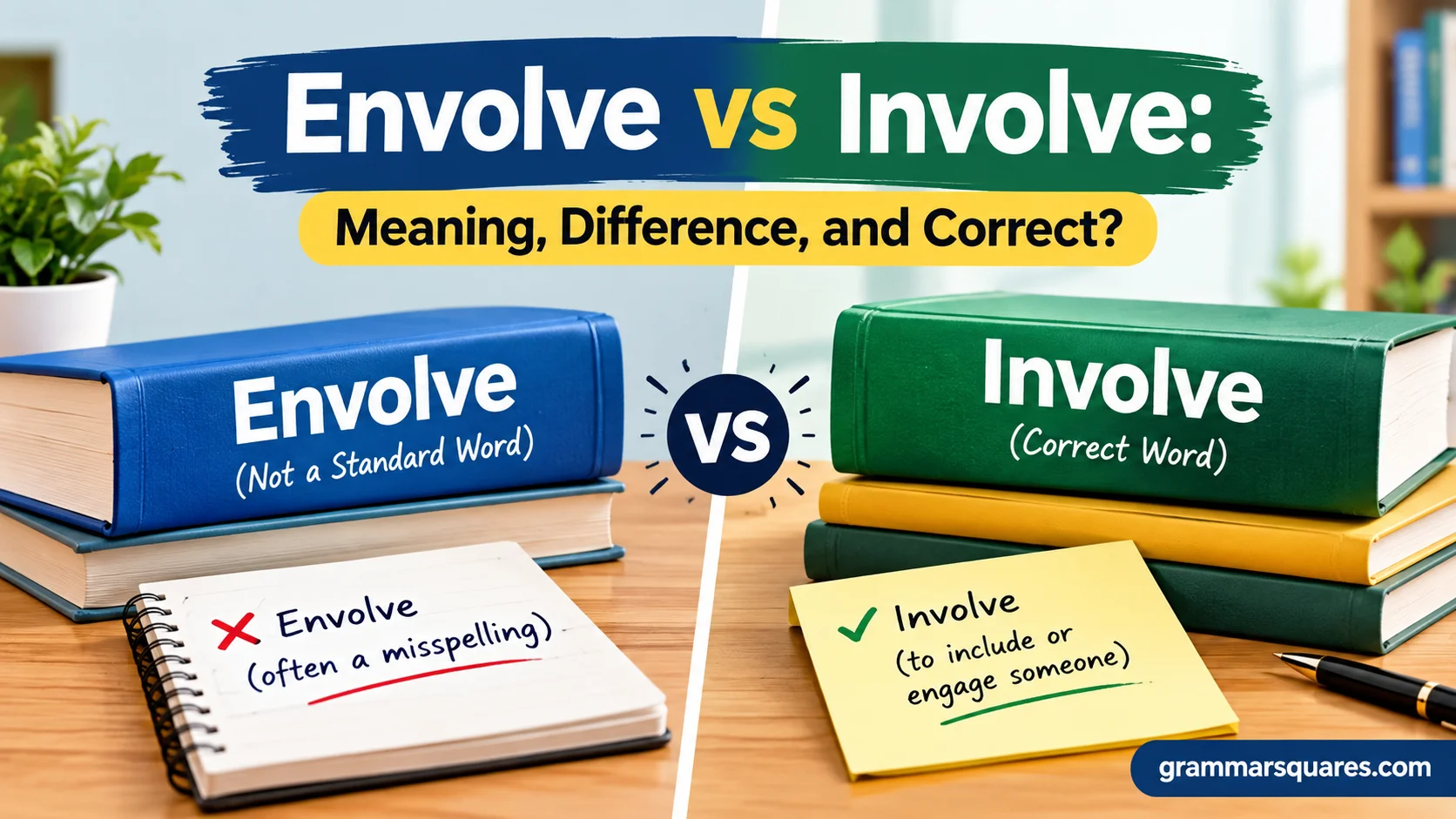

When learning English spelling and vocabulary, some words can look very similar but have very different meanings. Envolve vs Involve is one such confusing pair that can cause mistakes in everyday writing. While involve is a common and correct English word, envolve is generally not used as a standard modern English word. Understanding this spelling difference can help you write more clearly and avoid unnecessary errors.
The word involve is widely used in both formal and informal English. It can mean to include someone, require something, or make a person part of an activity or situation. For example, you might say that a project involves several people or that a job involves careful planning. Because of its many uses, involve appears frequently in conversations, emails, academic writing, and professional communication.
On the other hand, envolve is usually a misspelling of involve rather than a standard English word. If you are unsure which spelling to use, involve is normally the correct choice in modern English. Learning the difference between these two forms is especially useful when writing emails, essays, reports, and professional documents. In this guide, we’ll explain their meaning, usage, spelling, examples, and key differences in simple English.
Envolve vs Involve: Why This Confusion Happens in the First Place
Let’s start with the real issue. People don’t confuse these words because they’re careless. They confuse them because:
- The spelling looks almost identical
- The pronunciation feels similar when spoken quickly
- Multilingual influence plays a role (especially Portuguese and Spanish)
- Keyboard slips happen all the time
- Autocorrect sometimes “corrects” things incorrectly across languages
Here’s the key idea:
Your brain sees patterns, not correctness. So it fills gaps even when the word doesn’t belong.
That’s why “envolve” often appears in drafts even from strong writers.
But now let’s clear the confusion once and for all.
What Does “Involve” Mean in English? (Real Usage Explained)
The word involve is a standard English verb. It plays a big role in communication because it describes participation, inclusion, or connection.
Core meaning of involve
At its simplest:
Involve means to include someone or something as part of a situation, activity, or process.
But in real usage, it expands into several related ideas:
- To require participation
- To include as a necessary part
- To engage someone in an activity
- To bring someone into a situation (sometimes unwillingly)
Everyday examples of “involve”
You’ll see it everywhere in real life:
- “This job involves working with clients daily.”
- “I don’t want to involve you in this argument.”
- “The project involves multiple teams across departments.”
Notice something important: the word always connects people or things to an action or situation.
Different contexts where “involve” appears
Work and business
- Meetings involve decision-making
- Roles involve responsibilities
- Projects involve collaboration
Education
- Exams involve problem-solving
- Courses involve research and writing
Social situations
- Conversations involve emotional exchange
- Conflicts often involve multiple people
Synonyms of “involve”
To strengthen your vocabulary, here are useful alternatives:
- Include
- Require
- Entail
- Engage
- Incorporate
But be careful. These words don’t always match perfectly. For example:
- “Involve” suggests participation
- “Require” suggests necessity
- “Include” suggests part of a whole
So context matters.
Read More: Adjectives That Start With R: Powerful Words Organized?
Does “Envolve” Exist in English? The Truth
Now let’s address the real confusion point: envolve.
Short answer
“Envolve” is not a standard English word.
It does not appear in English dictionaries as a valid entry.
Why people think “envolve” exists
This is where things get interesting.
“Envolve” does exist in other languages:
- In Portuguese: envolver
- In Spanish influence contexts: similar forms appear in conjugation patterns
In Portuguese, “envolver” can mean:
- To involve
- To wrap
- To engage
- To get mixed up in something
So when bilingual speakers switch to English, their brain sometimes transfers spelling patterns directly.
That’s called language interference.
Important clarification
Let’s make this crystal clear:
| Word | Language Status | Meaning in English Context | Correct in English Writing |
| involve | Standard English | to include or engage | Yes |
| envolve | Non-English spelling | no valid English meaning | No |
What dictionaries say
Major English dictionaries (like Merriam-Webster and Oxford) list:
- involve ✔️
- involvement ✔️
- involved ✔️
But no entry exists for “envolve.”
That alone settles the question.
Envolve vs Involve: Key Differences Explained Clearly
Let’s simplify it even further.
| Feature | Involve | Envolve |
| Language | English | Portuguese / non-English usage |
| Valid in English writing | Yes | No |
| Meaning | To include or require participation | No recognized meaning in English |
| Usage frequency | Very common | Incorrect in English contexts |
| Example sentence | “The job involves travel.” | Not valid in English |
Simple takeaway
If you’re writing in English, always choose involve.
Treat “envolve” like a typo unless you are specifically writing in another language.
Common Mistakes People Make with Involve vs Envolve
Even experienced writers slip up. Let’s break down the most common mistakes so you can avoid them.
Mistake: Copying multilingual spelling habits
Writers who switch between languages often mix patterns.
Example:
- Incorrect: “The project will envolve multiple teams.”
- Correct: “The project will involve multiple teams.”
This happens especially in:
- International workplaces
- ESL writing environments
- Social media posts with fast typing
Mistake: Relying on autocorrect blindly
Autocorrect sometimes guesses wrong based on language settings.
You might type “involve,” but your keyboard suggests “envolve” if:
- Your device supports multiple languages
- Your dictionary includes Portuguese
Mistake: Assuming both words exist
Some learners assume:
“If it looks similar, it must be a variant spelling.”
But English does not work that way. Small spelling differences often mean completely different words—or in this case, no valid word at all.
Quick mistake checklist
Before you finalize writing, ask yourself:
- Does the word appear in an English dictionary?
- Does it pass spellcheck in English mode?
- Does the sentence sound natural when read aloud?
If any answer feels uncertain, double-check.
How to Remember the Correct Word Easily
Let’s make this practical. You don’t need grammar theory. You need memory tricks.
Memory trick: “IN = inside”
Think of it this way:
INvolve = something or someone is inside the situation
That mental image helps you lock it in.
Word association method
- involve → in + volve → “in the situation”
- envolve → no English meaning → ignore it
Read-it-out-loud test
Say the sentence aloud:
- “This task involves teamwork.” ✔️ Sounds natural
- “This task envolve teamwork.” ❌ Feels off immediately
Your ears often catch errors faster than your eyes.
Quick mental rule
If it doesn’t feel like something you’d say in conversation, it’s probably wrong.
Real-World Usage of “Involve” (Practical Examples)
Let’s ground this in real communication.
Workplace examples
- “The role involves customer support and data entry.”
- “We involve stakeholders early in the process to avoid delays.”
Education examples
- “The course involves weekly assignments and group projects.”
- “Research involves collecting and analyzing data.”
Social examples
- “I don’t want to involve you in this disagreement.”
- “Good friendships involve trust and honesty.”
Business strategy example
- “Successful marketing involves understanding customer behavior.”
Notice how flexible the word is. It connects actions, responsibilities, and relationships across contexts.
Quick Grammar Guide: When to Use “Involve” Correctly
Let’s simplify usage rules.
Use “involve” when:
- Something includes participation
- A situation requires action
- A process contains steps or people
Avoid “envolve” in:
- Emails
- Essays
- Blog posts
- Professional writing
- Academic content
Editing checklist
Before publishing:
- Check spelling
- Replace uncertain words
- Read aloud
- Run grammar tools
- Compare with dictionary usage
Case Study: How One Small Word Error Changes Writing Quality
Let’s look at a real-world style scenario.
Situation
An ESL student writes a business report:
“Our expansion plan envolve new partnerships across Europe.”
At first glance, the sentence feels fine. The meaning is clear.
But here’s what happens in evaluation:
- Grammar tools flag “envolve” as incorrect
- Readers notice inconsistency
- Professional credibility drops slightly
- Editors correct it to “involve”
Corrected version
“Our expansion plan involves new partnerships across Europe.”
What changed in perception
Even though the meaning stayed the same, the corrected sentence:
- Looks professional
- Matches English standards
- Builds trust with readers
- Improves readability
Key lesson
Small spelling errors don’t just break grammar. They affect credibility.
That’s why mastering tiny differences like Envolve vs Involve matters more than people think.
Conclusion
The difference between Envolve and Involve is mainly about correct spelling and usage. In modern standard English, involve is the correct and commonly used word. It can mean to include someone, require something, or make someone part of an activity or situation.
Envolve is generally considered a misspelling of involve when used in ordinary English writing. To avoid confusion, use involve in your emails, essays, articles, reports, and professional communication. Remembering this simple difference can help you make your writing more accurate, clear, and professional.
FAQs
Is “envolve” a correct English word?
No, envolve is generally not used as a standard modern English word. In most cases, it is a misspelling of involve.
What does “involve” mean?
Involve means to include someone or something in an activity, situation, or process. It can also mean that something requires a particular action or effort.
Is it “envolved” or “involved”?
The correct form is involved. For example, “She was involved in the project” is correct.
Why do people write “envolve” instead of “involve”?
The mistake often happens because envolve and involve look and sound somewhat similar. The standard spelling to use is involve.
What is an example of “involve”?
A simple example is: “The project will involve several team members.” Here, “involve” means that several team members will take part in the project.




1 thought on “Envolve vs Involve: Meaning, Difference, and Correct? ”